


The story of rural female folks in different parts of India.
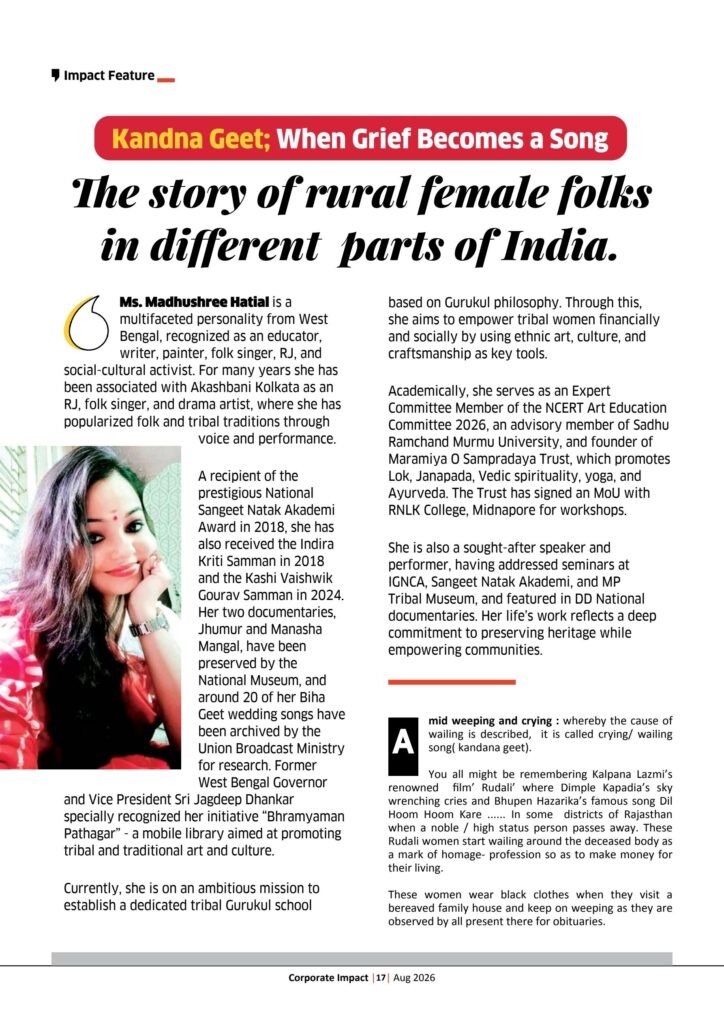
Ms. Hatial is a multifaceted personality from West Bengal, recognized as an educator, writer, painter, folk singer, RJ, and social-cultural activist. For many years she has been associated with Akashbani Kolkata as an RJ, folk singer, and drama artist, where she has popularized folk and tribal traditions through voice and performance.
A recipient of the prestigious National Sangeet Natak Akademi Award in 2018, she has also received the Indira Kriti Samman in 2018 and the Kashi Vaishwik Gourav Samman in 2024. Her two documentaries, Jhumur and Manasha Mangal, have been preserved by the National Museum, and around 20 of her Biha Geet wedding songs have been archived by the Union Broadcast Ministry for research. Former West Bengal Governor and Vice President Sri Jagdeep Dhankar specially recognized her initiative “Bhramyaman Pathagar” – a mobile library aimed at promoting tribal and traditional art and culture.
Currently, she is on an ambitious mission to establish a dedicated tribal Gurukul school based on Gurukul philosophy. Through this, she aims to empower tribal women financially and socially by using ethnic art, culture, and craftsmanship as key tools.
Academically, she serves as an Expert Committee Member of the NCERT Art Education Committee 2026, an advisory member of Sadhu Ramchand Murmu University, and founder of Maramiya O Sampradaya Trust, which promotes Lok, Janapada, Vedic spirituality, yoga, and Ayurveda. The Trust has signed an MoU with RNLK College, Midnapore for workshops.
She is also a sought-after speaker and performer, having addressed seminars at IGNCA, Sangeet Natak Akademi, and MP Tribal Museum, and featured in DD National documentaries. Her life’s work reflects a deep commitment to preserving heritage while empowering communities.
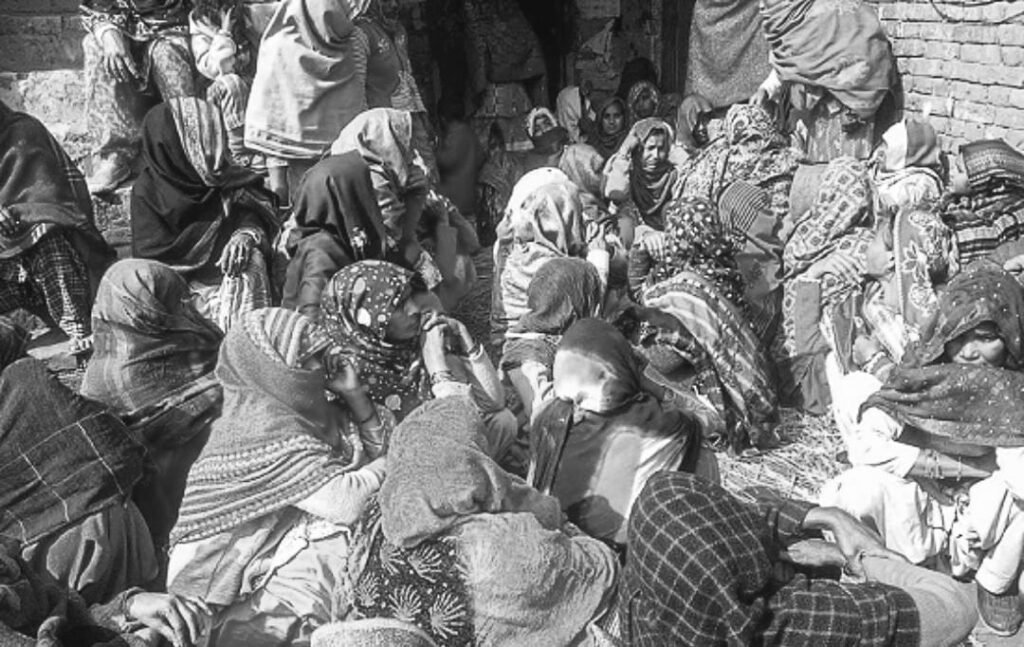
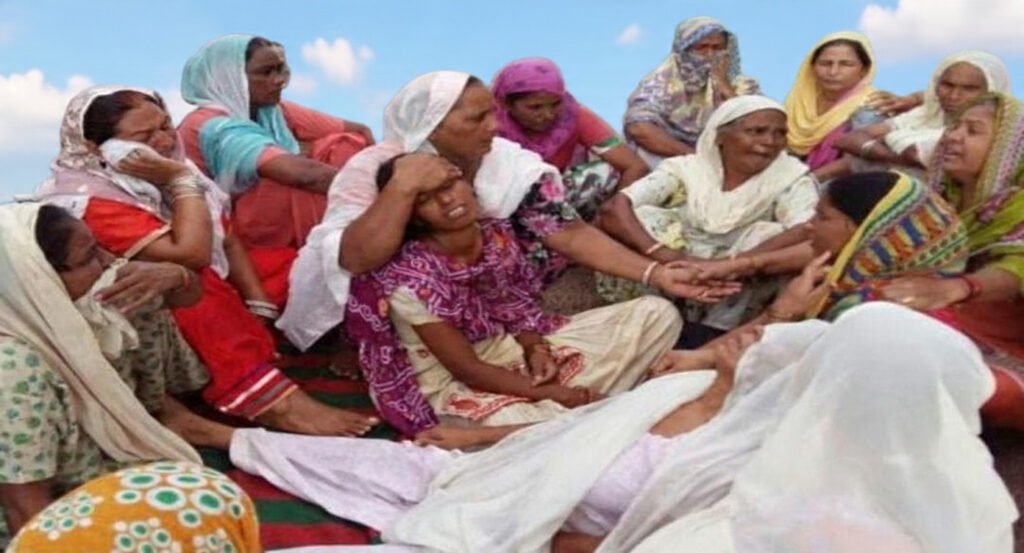
Amid weeping and crying : whereby the cause of wailing is described, it is called crying/ wailing song( kandana geet).
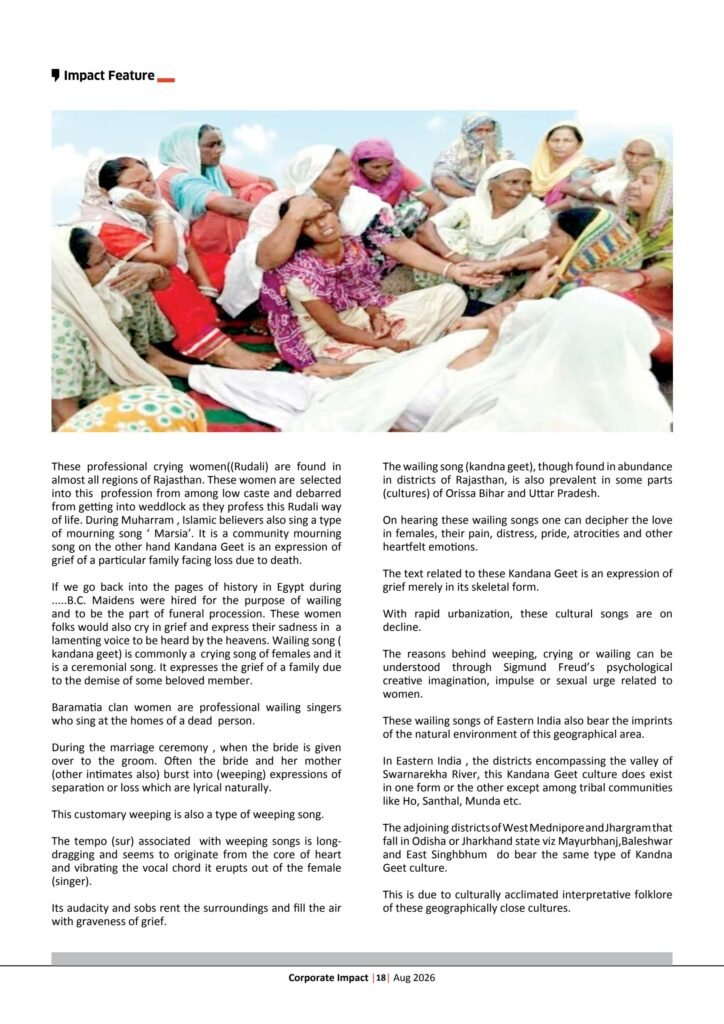
You all might be remembering Kalpana Lazmi’s renowned film’ Rudali’ where Dimple Kapadia’s sky wrenching cries and Bhupen Hazarika’s famous song Dil Hoom Hoom Kare …… In some districts of Rajasthan when a noble / high status person passes away. These Rudali women start wailing around the deceased body as a mark of homage- profession so as to make money for their living.
These women wear black clothes when they visit a bereaved family house and keep on weeping as they are observed by all present there for obituaries.
These professional crying women((Rudali) are found in almost all regions of Rajasthan. These women are selected into this profession from among low caste and debarred from getting into weddlock as they profess this Rudali way of life. During Muharram , Islamic believers also sing a type of mourning song ‘ Marsia’. It is a community mourning song on the other hand Kandana Geet is an expression of grief of a particular family facing loss due to death.
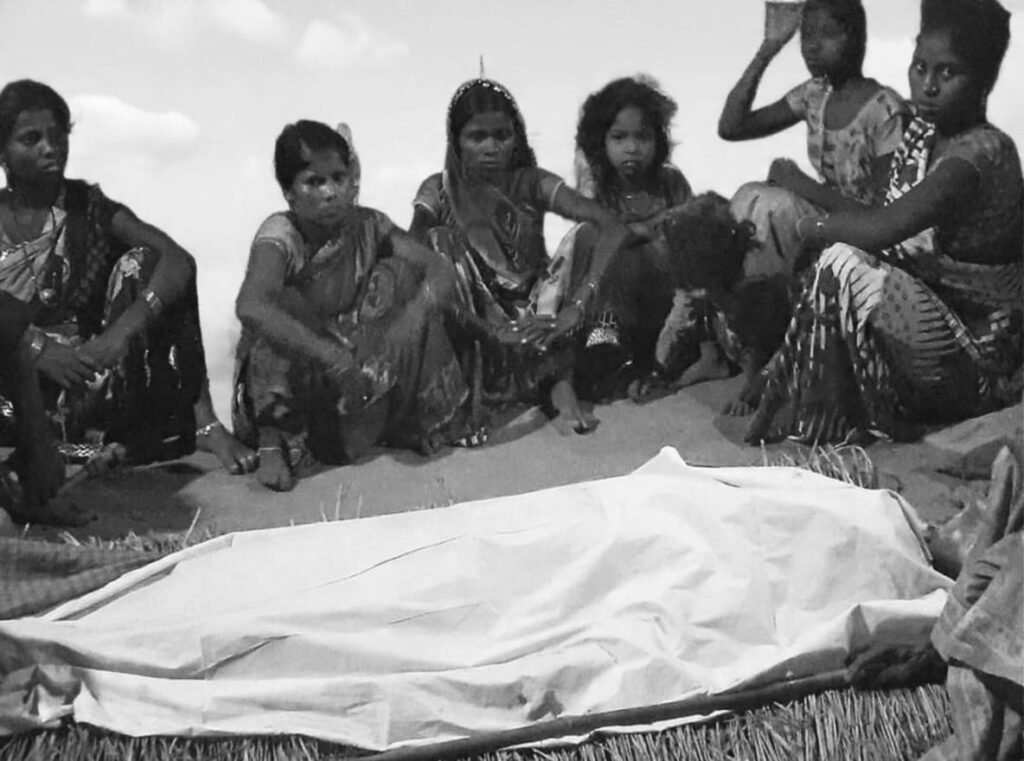
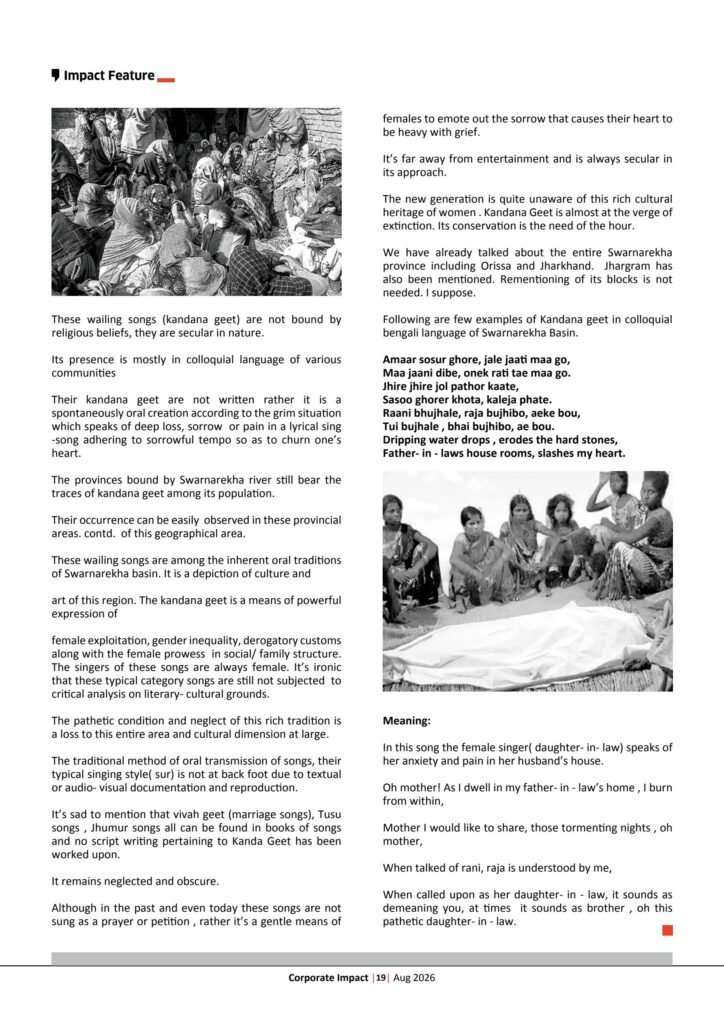
If we go back into the pages of history in Egypt during …..B.C. Maidens were hired for the purpose of wailing and to be the part of funeral procession. These women folks would also cry in grief and express their sadness in a lamenting voice to be heard by the heavens. Wailing song ( kandana geet) is commonly a crying song of females and it is a ceremonial song. It expresses the grief of a family due to the demise of some beloved member.
Baramatia clan women are professional wailing singers who sing at the homes of a dead person.
During the marriage ceremony , when the bride is given over to the groom. Often the bride and her mother (other intimates also) burst into (weeping) expressions of separation or loss which are lyrical naturally.
This customary weeping is also a type of weeping song.
The tempo (sur) associated with weeping songs is long- dragging and seems to originate from the core of heart and vibrating the vocal chord it erupts out of the female (singer).
Its audacity and sobs rent the surroundings and fill the air with graveness of grief.
The wailing song (kandna geet), though found in abundance in districts of Rajasthan, is also prevalent in some parts (cultures) of Orissa Bihar and Uttar Pradesh.
On hearing these wailing songs one can decipher the love in females, their pain, distress, pride, atrocities and other heartfelt emotions.
The text related to these Kandana Geet is an expression of grief merely in its skeletal form.
With rapid urbanization, these cultural songs are on decline.
The reasons behind weeping, crying or wailing can be understood through Sigmund Freud’s psychological creative imagination, impulse or sexual urge related to women.
These wailing songs of Eastern India also bear the imprints of the natural environment of this geographical area.
In Eastern India , the districts encompassing the valley of Swarnarekha River, this Kandana Geet culture does exist in one form or the other except among tribal communities like Ho, Santhal, Munda etc.
The adjoining districts of West Mednipore and Jhargram that fall in Odisha or Jharkhand state viz Mayurbhanj,Baleshwar and East Singhbhum do bear the same type of Kandna Geet culture.
This is due to culturally acclimated interpretative folklore of these geographically close cultures.
These wailing songs (kandana geet) are not bound by religious beliefs, they are secular in nature.
Its presence is mostly in colloquial language of various communities
Their kandana geet are not written rather it is a spontaneously oral creation according to the grim situation which speaks of deep loss, sorrow or pain in a lyrical sing -song adhering to sorrowful tempo so as to churn one’s heart.
The provinces bound by Swarnarekha river still bear the traces of kandana geet among its population.
Their occurrence can be easily observed in these provincial areas. contd. of this geographical area.
These wailing songs are among the inherent oral traditions of Swarnarekha basin. It is a depiction of culture and
art of this region. The kandana geet is a means of powerful expression of
female exploitation, gender inequality, derogatory customs along with the female prowess in social/ family structure. The singers of these songs are always female. It’s ironic that these typical category songs are still not subjected to critical analysis on literary- cultural grounds.
The pathetic condition and neglect of this rich tradition is a loss to this entire area and cultural dimension at large.
The traditional method of oral transmission of songs, their typical singing style( sur) is not at back foot due to textual or audio- visual documentation and reproduction.
It’s sad to mention that vivah geet (marriage songs), Tusu songs , Jhumur songs all can be found in books of songs and no script writing pertaining to Kanda Geet has been worked upon.
It remains neglected and obscure.
Although in the past and even today these songs are not sung as a prayer or petition , rather it’s a gentle means of females to emote out the sorrow that causes their heart to be heavy with grief.
It’s far away from entertainment and is always secular in its approach.
The new generation is quite unaware of this rich cultural heritage of women . Kandana Geet is almost at the verge of extinction. Its conservation is the need of the hour.
We have already talked about the entire Swarnarekha province including Orissa and Jharkhand. Jhargram has also been mentioned. Rementioning of its blocks is not needed. I suppose.
Following are few examples of Kandana geet in colloquial bengali language of Swarnarekha Basin.
Amaar sosur ghore, jale jaati maa go,
Maa jaani dibe, onek rati tae maa go.
Jhire jhire jol pathor kaate,
Sasoo ghorer khota, kaleja phate.
Raani bhujhale, raja bujhibo, aeke bou,
Tui bujhale , bhai bujhibo, ae bou.
Dripping water drops , erodes the hard stones,
Father- in – laws house rooms, slashes my heart.
Meaning:
In this song the female singer( daughter- in- law) speaks of her anxiety and pain in her husband’s house.
Oh mother! As I dwell in my father- in – law’s home , I burn from within,
Mother I would like to share, those tormenting nights , oh mother,
When talked of rani, raja is understood by me,
When called upon as her daughter- in – law, it sounds as demeaning you, at times it sounds as brother , oh this pathetic daughter- in – law.