


In Ayurveda, concepts like Garbha Sanskar and Beej Shuddhi emphasize preparing the body before conception.
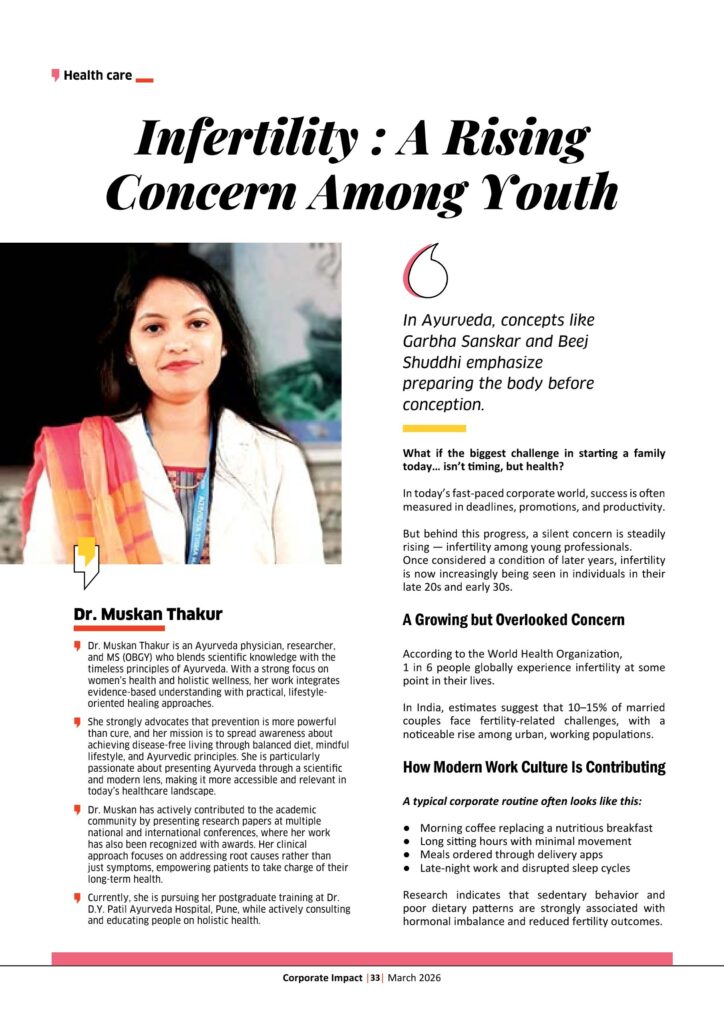
Dr. Muskan Thakur
Dr. Muskan Thakur is an Ayurveda physician, researcher, and MS (OBGY) who blends scientific knowledge with the timeless principles of Ayurveda. With a strong focus on women’s health and holistic wellness, her work integrates evidence-based understanding with practical, lifestyle-oriented healing approaches.
She strongly advocates that prevention is more powerful than cure, and her mission is to spread awareness about achieving disease-free living through balanced diet, mindful lifestyle, and Ayurvedic principles. She is particularly passionate about presenting Ayurveda through a scientific and modern lens, making it more accessible and relevant in today’s healthcare landscape.
Dr. Muskan has actively contributed to the academic community by presenting research papers at multiple national and international conferences, where her work has also been recognized with awards. Her clinical approach focuses on addressing root causes rather than just symptoms, empowering patients to take charge of their long-term health.
Currently, she is pursuing her postgraduate training at Dr. D.Y. Patil Ayurveda Hospital, Pune, while actively consulting and educating people on holistic health.

What if the biggest challenge in starting a family today… isn’t timing, but health?
In today’s fast-paced corporate world, success is often measured in deadlines, promotions, and productivity.
But behind this progress, a silent concern is steadily rising — infertility among young professionals.
Once considered a condition of later years, infertility is now increasingly being seen in individuals in their late 20s and early 30s.
A Growing but Overlooked Concern
According to the World Health Organization,
1 in 6 people globally experience infertility at some point in their lives.
In India, estimates suggest that 10–15% of married couples face fertility-related challenges, with a noticeable rise among urban, working populations.
How Modern Work Culture Is Contributing
A typical corporate routine often looks like this:
● Morning coffee replacing a nutritious breakfast
● Long sitting hours with minimal movement
● Meals ordered through delivery apps
● Late-night work and disrupted sleep cycles
Research indicates that sedentary behavior and poor dietary patterns are strongly associated with hormonal imbalance and reduced fertility outcomes.
The Hormonal Connection
Reproductive health is closely linked to hormonal balance.
Today, conditions such as PCOS,Thyroid disorders,Insulin resistance are increasingly common among young professionals.
Studies suggest that PCOS alone affects nearly 1 in 5 women in India, making it one of the leading causes of infertility.
In men, research has shown a gradual decline in sperm count globally over the past few decades, often linked to lifestyle and environmental factors.
The Hidden Impact of Stress
Chronic stress is another major factor.
Work pressure, deadlines, and lack of work-life balance lead to sustained elevation of stress hormones like cortisol.
Scientific evidence shows that chronic stress can disrupt the hypothalamic–pituitary–gonadal (HPG) axis, affecting:
● Ovulation in women
● Sperm production in men
● Overall reproductive function
More Than Just a Medical Issue
Infertility today is not just a medical condition — it is often a reflection of lifestyle, nutrition, and stress levels.
From a holistic perspective, reproductive health depends on proper nourishment, metabolism, and internal balance.
When these are disturbed, the body prioritizes survival over reproduction.
Why Early Awareness Matters
Many individuals assume fertility will remain unaffected until they decide to plan a family. However, research suggests that delayed intervention significantly reduces treatment success rates.
Ignoring early signs such as:
● Irregular periods
● Weight fluctuations
● Chronic fatigue
can lead to progression of underlying conditions.
The Shift Toward Preventive Health
The good news is — small changes can make a significant difference.
Evidence supports that lifestyle modifications can improve fertility outcomes by up to 30–40% in certain cases, especially where metabolic factors are involved.
Simple steps include:
● Choosing fresh, home-cooked meals over processed foods
● Maintaining regular physical activity
● Prioritizing sleep and recovery
● Managing stress effectively
● Seeking timely medical guidance
A Holistic Way Forward
While modern medicine continues to offer advanced solutions for infertility, there is also a growing need to focus on prevention and root-cause correction.
In Ayurveda, concepts like Garbha Sanskar and Beej Shuddhi emphasize preparing the body before conception.
● Beej Shuddhi focuses on improving the quality of sperm and ovum
● Garbha Sanskar supports physical, mental, and emotional readiness for a healthy pregnancy
This approach works on Enhancing reproductive tissue quality,Correcting metabolic imbalances,Reducing stress and improving overall well-being.
Rather than viewing fertility as a last-minute concern, Ayurveda encourages individuals to nurture reproductive health proactively.
Final Thought
Infertility is no longer just a medical condition —
it is a reflection of how we live.
Creating awareness about early care, lifestyle balance, and holistic preparation is essential.
Because the goal is not just conception —
but the foundation of a healthy next generation.
And spreading this awareness is not just important —
it is the need of the hour.
In the pursuit of professional success, health often takes a back seat.
But when it comes to fertility, the cost of neglect can be long-term.
Because in the end, the most important investment is not just in your career —
It is in your health and future.