


One of the most encouraging facts about suicide prevention is that suicide is preventable and requires awareness.
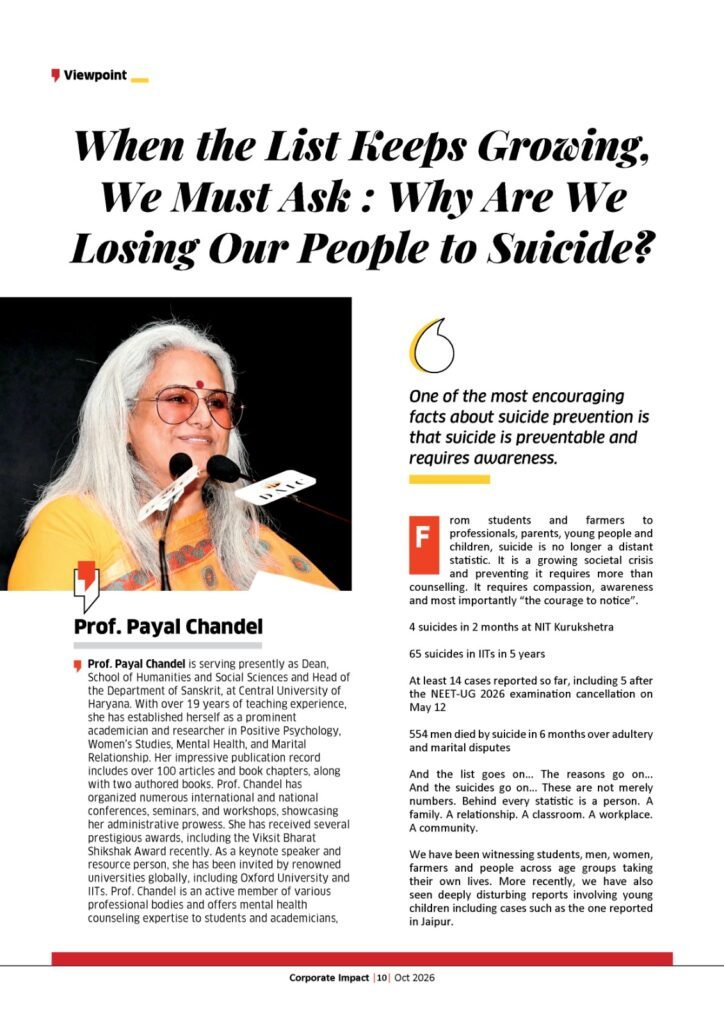
Prof. Payal Chandel
Prof. Payal Chandel is serving presently as Dean, School of Humanities and Social Sciences and Head of the Department of Sanskrit, at Central University of Haryana. With over 19 years of teaching experience, she has established herself as a prominent academician and researcher in Positive Psychology, Women’s Studies, Mental Health, and Marital Relationship. Her impressive publication record includes over 100 articles and book chapters, along with two authored books. Prof. Chandel has organized numerous international and national conferences, seminars, and workshops, showcasing her administrative prowess. She has received several prestigious awards, including the Viksit Bharat Shikshak Award recently. As a keynote speaker and resource person, she has been invited by renowned universities globally, including Oxford University and IITs. Prof. Chandel is an active member of various professional bodies and offers mental health counseling expertise to students and academicians, inspiring a new generation of leaders.

From students and farmers to professionals, parents, young people and children, suicide is no longer a distant statistic. It is a growing societal crisis and preventing it requires more than counselling. It requires compassion, awareness and most importantly “the courage to notice”.
4 suicides in 2 months at NIT Kurukshetra
65 suicides in IITs in 5 years
At least 14 cases reported so far, including 5 after the NEET-UG 2026 examination cancellation on May 12
554 men died by suicide in 6 months over adultery and marital disputes
And the list goes on… The reasons go on… And the suicides go on… These are not merely numbers. Behind every statistic is a person. A family. A relationship. A classroom. A workplace. A community.
We have been witnessing students, men, women, farmers and people across age groups taking their own lives. More recently, we have also seen deeply disturbing reports involving young children including cases such as the one reported in Jaipur.
Every life lost to suicide is a collective failure of us as a society.
Not necessarily because someone failed to provide a perfect solution but because somewhere along the way, a person may have felt that there was no other way to end their suffering.
Perhaps They Did Not Want to End Their Life. Perhaps They Wanted to End Their Pain.
One of the most important things we need to understand about suicide is that a suicidal crisis can be temporary, even when the suffering feels permanent. Research on suicidal behaviour has repeatedly shown that many people who survive an attempt, do not go on to die by suicide later. This tells us something profoundly important: a suicidal crisis can pass, and an intervention at the right moment can save a life.

The purpose may not always be to end life itself. It may be an desperate attempt to end the suffering, pain, helplessness, hopelessness or unbearable emotional distress that the person is experiencing. And sometimes, what the person needs most in that moment is not a lecture, criticism or judgment. They need someone to notice, someone to listen, someone to stay.
Suicide Is Preventable, only if We
Learn to Recognise the Signals
One of the most encouraging facts about suicide prevention is that suicide is preventable and requires awareness. It requires us to recognise the warning signs and understand what action to take when we see them. These red flags can broadly be understood in three categories: verbal, behavioural and emotional signals.
VERBAL SIGNALS
A person experiencing suicidal thoughts may talk about death or suicide directly or indirectly.
They may say:
“I want to take my life.”
“Nobody loves me.”
“No one cares about me.”
“My life is not worth living.”
“I want to end my life.”
Sometimes these statements may indicate a direct intention to die. At other times, they may be expressions of overwhelming emotional pain or hopelessness. They should never simply be dismissed. If someone around you is talking in this way, do not immediately label it as “attention seeking” or “threatening.” Take it seriously, they may be thinking about ending their life and may need help
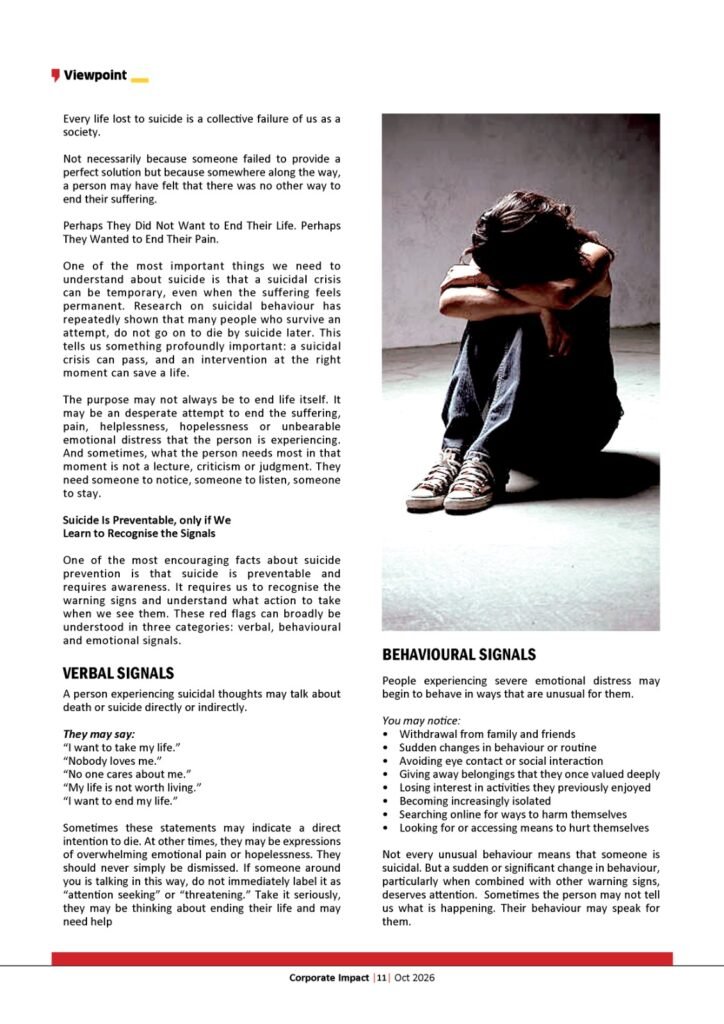
BEHAVIOURAL SIGNALS
People experiencing severe emotional distress may begin to behave in ways that are unusual for them.
You may notice:
• Withdrawal from family and friends
• Sudden changes in behaviour or routine
• Avoiding eye contact or social interaction
• Giving away belongings that they once valued deeply
• Losing interest in activities they previously enjoyed
• Becoming increasingly isolated
• Searching online for ways to harm themselves
• Looking for or accessing means to hurt themselves
Not every unusual behaviour means that someone is suicidal. But a sudden or significant change in behaviour, particularly when combined with other warning signs, deserves attention. Sometimes the person may not tell us what is happening. Their behaviour may speak for them.
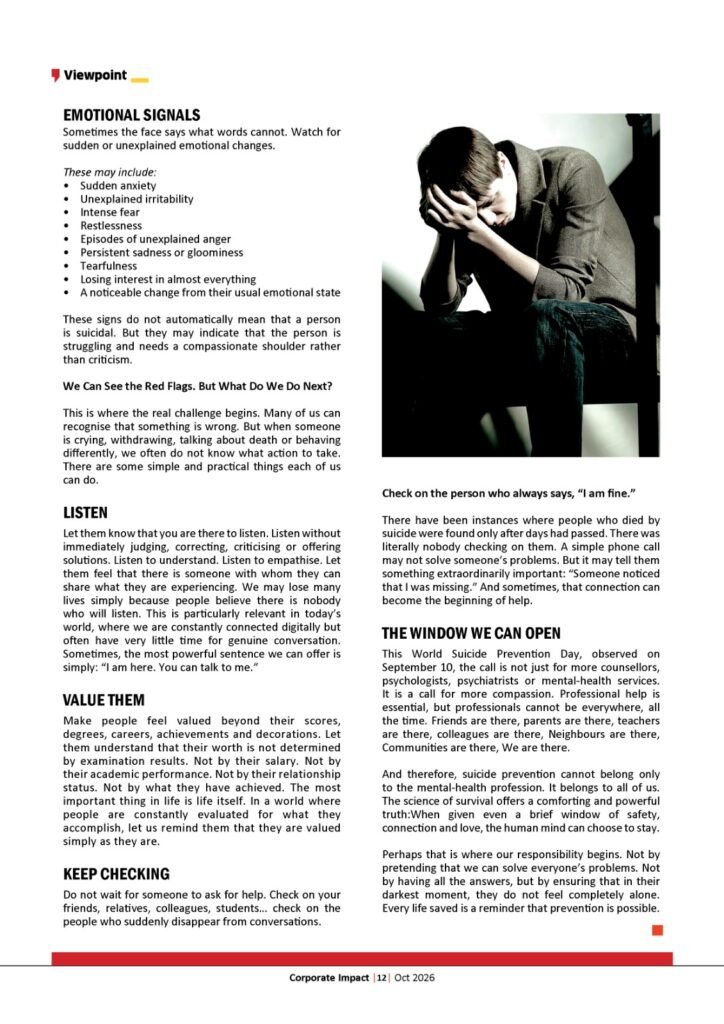
EMOTIONAL SIGNALS
Sometimes the face says what words cannot. Watch for sudden or unexplained emotional changes.
These may include:
• Sudden anxiety
• Unexplained irritability
• Intense fear
• Restlessness
• Episodes of unexplained anger
• Persistent sadness or gloominess
• Tearfulness
• Losing interest in almost everything
• A noticeable change from their usual emotional state

These signs do not automatically mean that a person is suicidal. But they may indicate that the person is struggling and needs a compassionate shoulder rather than criticism.
We Can See the Red Flags. But What Do We Do Next?
This is where the real challenge begins. Many of us can recognise that something is wrong. But when someone is crying, withdrawing, talking about death or behaving differently, we often do not know what action to take. There are some simple and practical things each of us can do.
LISTEN
Let them know that you are there to listen. Listen without immediately judging, correcting, criticising or offering solutions. Listen to understand. Listen to empathise. Let them feel that there is someone with whom they can share what they are experiencing. We may lose many lives simply because people believe there is nobody who will listen. This is particularly relevant in today’s world, where we are constantly connected digitally but often have very little time for genuine conversation. Sometimes, the most powerful sentence we can offer is simply: “I am here. You can talk to me.”
VALUE THEM
Make people feel valued beyond their scores, degrees, careers, achievements and decorations. Let them understand that their worth is not determined by examination results. Not by their salary. Not by their academic performance. Not by their relationship status. Not by what they have achieved. The most important thing in life is life itself. In a world where people are constantly evaluated for what they accomplish, let us remind them that they are valued simply as they are.
KEEP CHECKING
Do not wait for someone to ask for help. Check on your friends, relatives, colleagues, students… check on the people who suddenly disappear from conversations.
Check on the person who always says, “I am fine.”
There have been instances where people who died by suicide were found only after days had passed. There was literally nobody checking on them. A simple phone call may not solve someone’s problems. But it may tell them something extraordinarily important: “Someone noticed that I was missing.” And sometimes, that connection can become the beginning of help.
THE WINDOW WE CAN OPEN
This World Suicide Prevention Day, observed on September 10, the call is not just for more counsellors, psychologists, psychiatrists or mental-health services. It is a call for more compassion. Professional help is essential, but professionals cannot be everywhere, all the time. Friends are there, parents are there, teachers are there, colleagues are there, Neighbours are there, Communities are there, We are there.
And therefore, suicide prevention cannot belong only to the mental-health profession. It belongs to all of us. The science of survival offers a comforting and powerful truth:When given even a brief window of safety, connection and love, the human mind can choose to stay.
Perhaps that is where our responsibility begins. Not by pretending that we can solve everyone’s problems. Not by having all the answers, but by ensuring that in their darkest moment, they do not feel completely alone. Every life saved is a reminder that prevention is possible.