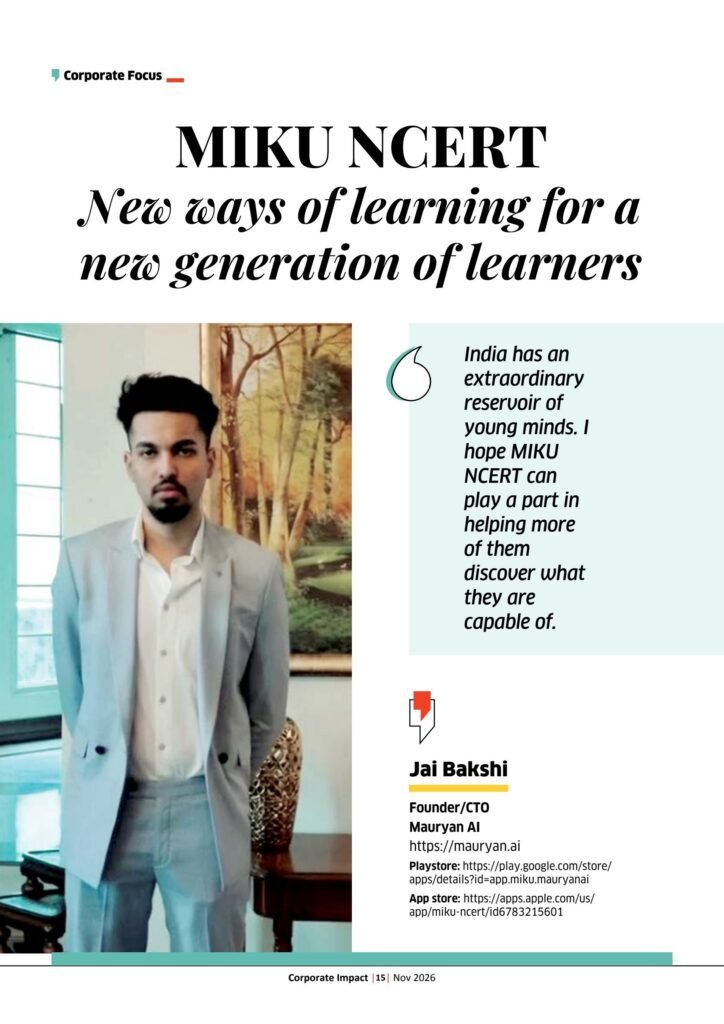



India has an extraordinary reservoir of young minds. I hope MIKU NCERT can play a part in helping more of them discover what they are capable of.
Jai Bakshi
Founder/CTO
Mauryan AI
https://mauryan.ai
Playstore: https://play.google.com/store/apps/details?id=app.miku.mauryanai
App store: https://apps.apple.com/us/app/miku-ncert/id6783215601
In a perpetually evolving world, education will remain essential even in the face of rapid technological advancement. Artificial intelligence has expanded our reach as a species and will continue to do so for the foreseeable future. I believe the ways in which we teach must evolve alongside it.
After having studied mathematics and the sciences in this country during my schooling and outside this country during my higher education, I came to the realization that there are a plethora of ways to teach the same topics to students. In my experience of schooling in India, the approach was heavily reliant on building a memorization-centric base, followed by rigorous practice. This methodology was far too familiar to me during my PCM years under the CBSE curriculum. It was only during my undergraduate studies that I unlearned the tried and tested exam tricks in favor of a more holistic understanding of the subjects I cherished.
This shift also made me attentive to the differences in how engineers approach unfamiliar problems. I observed cardinal differences in how American engineers look at and simplify complex systems compared to the approaches I had grown familiar with. There is no shortage of engineers in India, but I believe we need to do more to cultivate intuitive problem solvers. It is one thing to go by the book while approaching a new project. However, the problem arises when critical thinking does not extend beyond what has been written on an exam sheet. In my experience, the emphasis in American higher education seemed to lie more on building contextual understanding of hard-to-grasp topics through visualization, hands-on exploration and a gradual buildup of intuition rather than rote learning.
It was this shift in my own understanding that inspired me to start MIKU NCERT. I wanted to bring new ways of learning to students who, much like my younger self, might be capable of solving a question on paper without fully appreciating the idea behind it. The curriculum already holds an abundance of knowledge. What interested me was how we could make that knowledge more intuitive, engaging and accessible. With MIKU NCERT, we have sought to bring these possibilities into the familiarity of the Indian classroom. Built around the NCERT curriculum for Classes 8 to 12, the initiative approaches mathematics and science through visual explanations, guided practice and a gradual development of conceptual understanding. A student should have the opportunity to see a concept unfold, understand why a method works and then apply it independently.

This philosophy runs through the different parts of the product. Our Study section uses visual storytelling to make abstract ideas easier to grasp. Practice combines questions of varying difficulty with detailed explanations, while Thought Templates help students understand the reasoning behind a solution and recognize where that reasoning can be applied again. Homework support provides progressive hints before the final answer, encouraging students to participate in the process of arriving at it. Ask MIKU gives them a way to explore doubts, while progress tracking helps them follow their learning journey.
Making this experience available in both English and Hindi was equally important to me. A student’s curiosity should have room to grow in a language they understand. My hope is for MIKU NCERT to reach students across schools, cities and smaller towns, giving more of them access to approaches that can make a difficult subject feel approachable.
I understand the importance of examinations in our education system. I have spent enough years preparing for them myself. But I also believe that preparation can leave a student with something more enduring than a remembered solution. It can build the confidence to approach an unfamiliar problem, ask a meaningful question and persist long enough to discover an answer.
MIKU NCERT is my attempt to contribute to that possibility. It is an initiative born out of my own experience of discovering how differently the same subject can be understood when it is taught differently. There is much for us to build and learn along the way, but the purpose remains clear: to make room for curiosity, strengthen understanding and introduce new ways of learning to students who deserve that opportunity.
India has an extraordinary reservoir of young minds. I hope MIKU NCERT can play a part in helping more of them discover what they are capable of. A lesson understood today can become the foundation of an idea tomorrow. Further, a student who learns to think independently can one day create something that none of us have yet imagined.