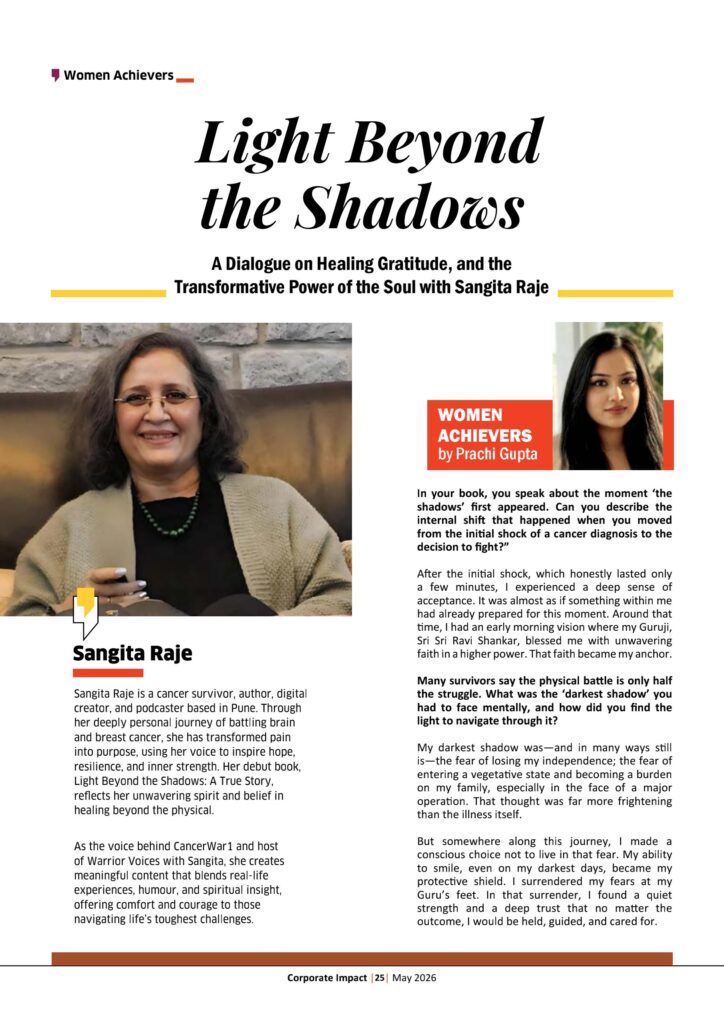

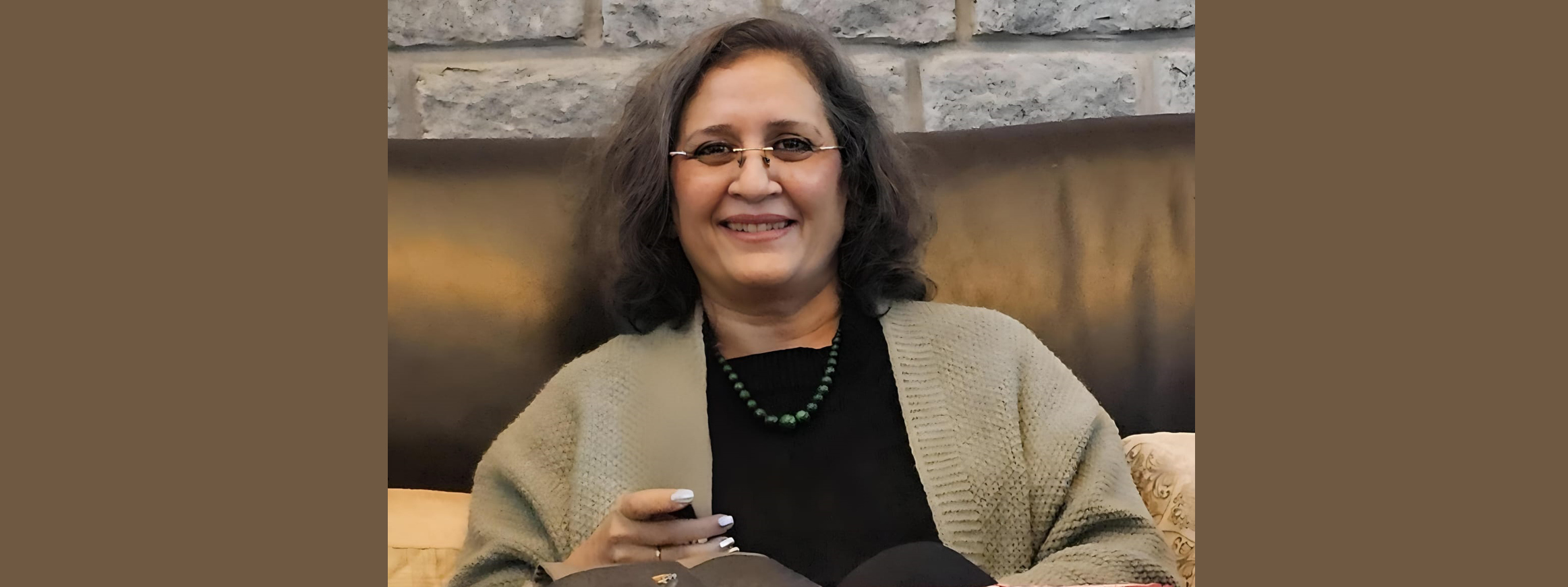
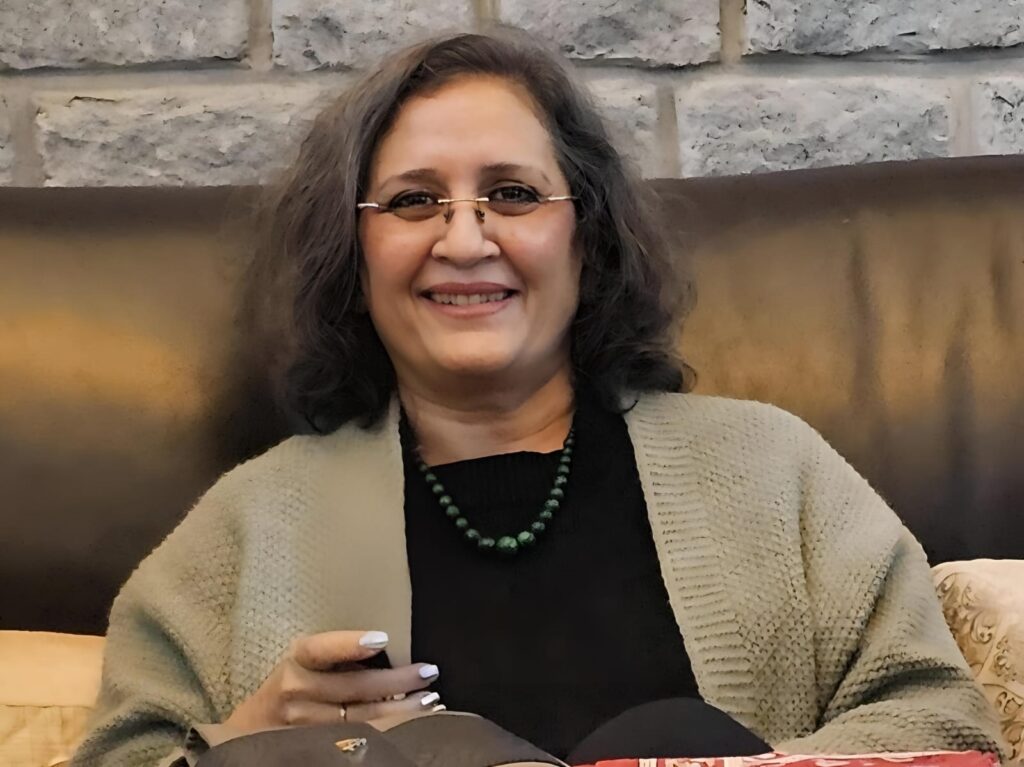
Sangita Raje
Sangita Raje is a cancer survivor, author, digital creator, and podcaster based in Pune. Through her deeply personal journey of battling brain and breast cancer, she has transformed pain into purpose, using her voice to inspire hope, resilience, and inner strength. Her debut book, Light Beyond the Shadows: A True Story, reflects her unwavering spirit and belief in healing beyond the physical.
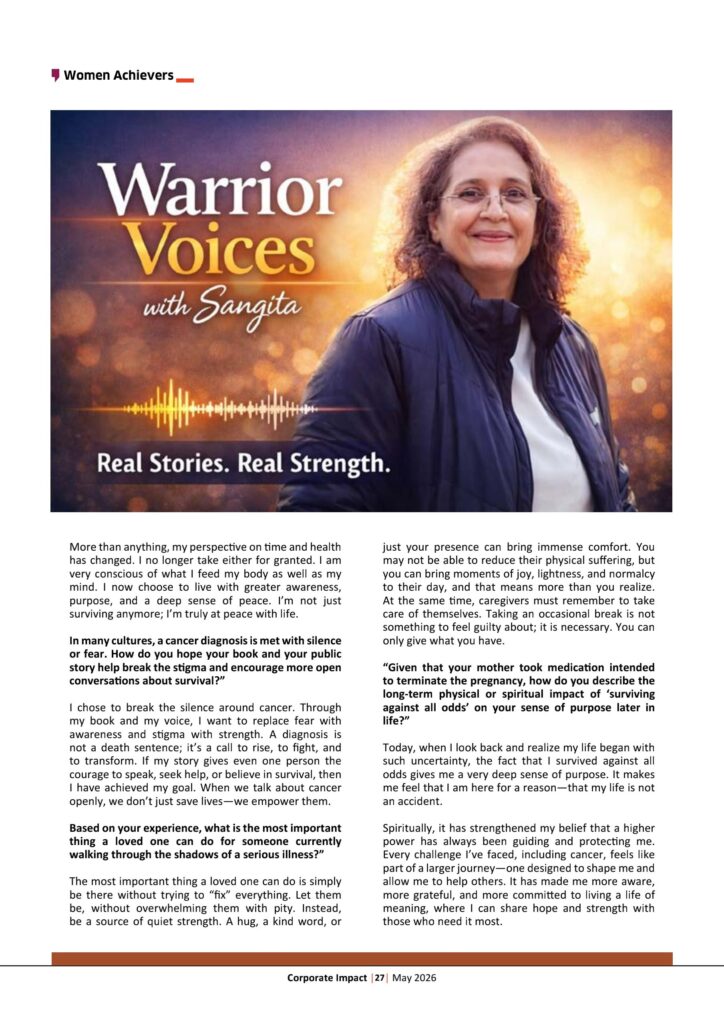
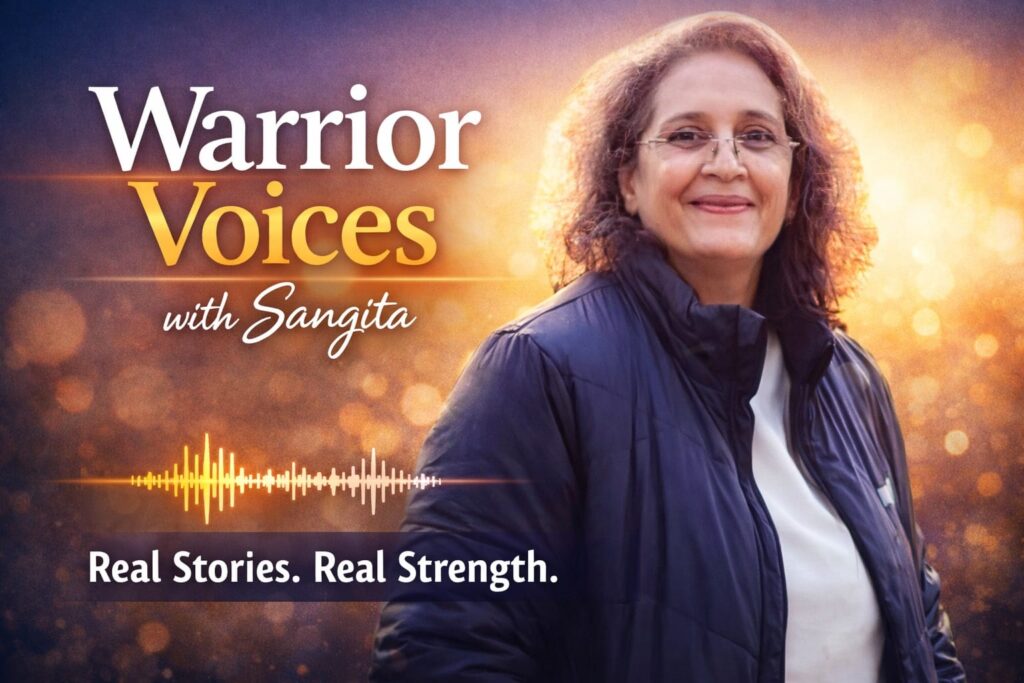
As the voice behind CancerWar1 and host of Warrior Voices with Sangita, she creates meaningful content that blends real-life experiences, humour, and spiritual insight, offering comfort and courage to those navigating life’s toughest challenges.
In your book, you speak about the moment ‘the shadows’ first appeared. Can you describe the internal shift that happened when you moved from the initial shock of a cancer diagnosis to the decision to fight?”
After the initial shock, which honestly lasted only a few minutes, I experienced a deep sense of acceptance. It was almost as if something within me had already prepared for this moment. Around that time, I had an early morning vision where my Guruji, Sri Sri Ravi Shankar, blessed me with unwavering faith in a higher power. That faith became my anchor.
Many survivors say the physical battle is only half the struggle. What was the ‘darkest shadow’ you had to face mentally, and how did you find the light to navigate through it?
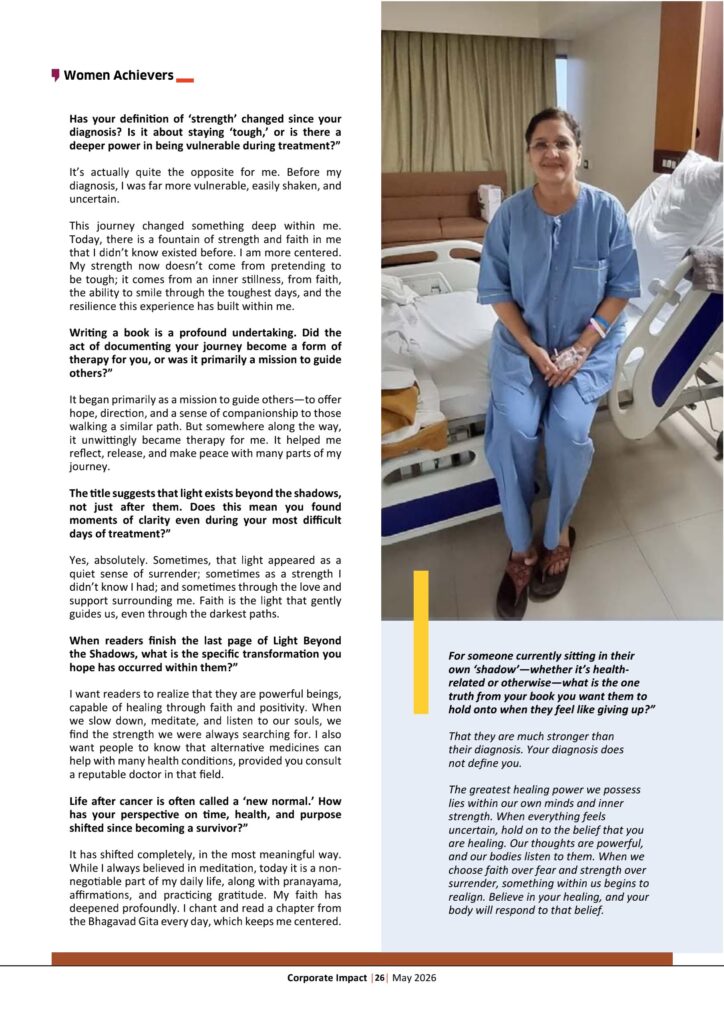
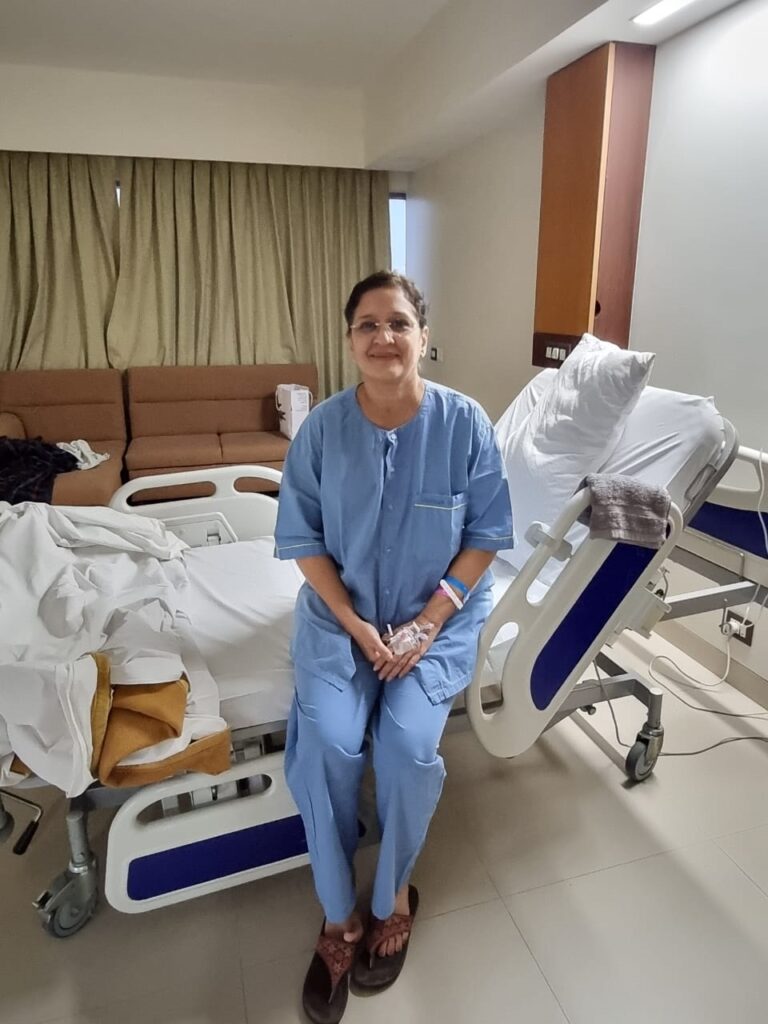
My darkest shadow was—and in many ways still is—the fear of losing my independence; the fear of entering a vegetative state and becoming a burden on my family, especially in the face of a major operation. That thought was far more frightening than the illness itself.
But somewhere along this journey, I made a conscious choice not to live in that fear. My ability to smile, even on my darkest days, became my protective shield. I surrendered my fears at my Guru’s feet. In that surrender, I found a quiet strength and a deep trust that no matter the outcome, I would be held, guided, and cared for.
Has your definition of ‘strength’ changed since your diagnosis? Is it about staying ‘tough,’ or is there a deeper power in being vulnerable during treatment?”
It’s actually quite the opposite for me. Before my diagnosis, I was far more vulnerable, easily shaken, and uncertain.
This journey changed something deep within me. Today, there is a fountain of strength and faith in me that I didn’t know existed before. I am more centered. My strength now doesn’t come from pretending to be tough; it comes from an inner stillness, from faith, the ability to smile through the toughest days, and the resilience this experience has built within me.
Writing a book is a profound undertaking. Did the act of documenting your journey become a form of therapy for you, or was it primarily a mission to guide others?”
It began primarily as a mission to guide others—to offer hope, direction, and a sense of companionship to those walking a similar path. But somewhere along the way, it unwittingly became therapy for me. It helped me reflect, release, and make peace with many parts of my journey.
The title suggests that light exists beyond the shadows, not just after them. Does this mean you found moments of clarity even during your most difficult days of treatment?”
Yes, absolutely. Sometimes, that light appeared as a quiet sense of surrender; sometimes as a strength I didn’t know I had; and sometimes through the love and support surrounding me. Faith is the light that gently guides us, even through the darkest paths.
When readers finish the last page of Light Beyond the Shadows, what is the specific transformation you hope has occurred within them?”
I want readers to realize that they are powerful beings, capable of healing through faith and positivity. When we slow down, meditate, and listen to our souls, we find the strength we were always searching for. I also want people to know that alternative medicines can help with many health conditions, provided you consult a reputable doctor in that field.
Life after cancer is often called a ‘new normal.’ How has your perspective on time, health, and purpose shifted since becoming a survivor?”
It has shifted completely, in the most meaningful way. While I always believed in meditation, today it is a non-negotiable part of my daily life, along with pranayama, affirmations, and practicing gratitude. My faith has deepened profoundly. I chant and read a chapter from the Bhagavad Gita every day, which keeps me centered.
More than anything, my perspective on time and health has changed. I no longer take either for granted. I am very conscious of what I feed my body as well as my mind. I now choose to live with greater awareness, purpose, and a deep sense of peace. I’m not just surviving anymore; I’m truly at peace with life.
For someone currently sitting in their own ‘shadow’—whether it’s health-related or otherwise—what is the one truth from your book you want them to hold onto when they feel like giving up?”
That they are much stronger than
their diagnosis. Your diagnosis does
not define you.
The greatest healing power we possess lies within our own minds and inner strength. When everything feels uncertain, hold on to the belief that you are healing. Our thoughts are powerful, and our bodies listen to them. When we choose faith over fear and strength over surrender, something within us begins to realign. Believe in your healing, and your body will respond to that belief.
In many cultures, a cancer diagnosis is met with silence or fear. How do you hope your book and your public story help break the stigma and encourage more open conversations about survival?”
I chose to break the silence around cancer. Through my book and my voice, I want to replace fear with awareness and stigma with strength. A diagnosis is not a death sentence; it’s a call to rise, to fight, and to transform. If my story gives even one person the courage to speak, seek help, or believe in survival, then I have achieved my goal. When we talk about cancer openly, we don’t just save lives—we empower them.
Based on your experience, what is the most important thing a loved one can do for someone currently walking through the shadows of a serious illness?”
The most important thing a loved one can do is simply be there without trying to “fix” everything. Let them be, without overwhelming them with pity. Instead, be a source of quiet strength. A hug, a kind word, or just your presence can bring immense comfort. You may not be able to reduce their physical suffering, but you can bring moments of joy, lightness, and normalcy to their day, and that means more than you realize. At the same time, caregivers must remember to take care of themselves. Taking an occasional break is not something to feel guilty about; it is necessary. You can only give what you have.
“Given that your mother took medication intended to terminate the pregnancy, how do you describe the long-term physical or spiritual impact of ‘surviving against all odds’ on your sense of purpose later in life?”
Today, when I look back and realize my life began with such uncertainty, the fact that I survived against all odds gives me a very deep sense of purpose. It makes me feel that I am here for a reason—that my life is not an accident.
Spiritually, it has strengthened my belief that a higher power has always been guiding and protecting me. Every challenge I’ve faced, including cancer, feels like part of a larger journey—one designed to shape me and allow me to help others. It has made me more aware, more grateful, and more committed to living a life of meaning, where I can share hope and strength with those who need it most.
The book details the dramatic moment where you were exchanged with a Doodhwali’s (milkmaid’s) baby at birth. How did the eventual discovery of this exchange shape your understanding of ‘destiny’ versus ‘heritage’ as you navigated your identity?”
That experience shaped my understanding in a profound way. It made me realize that while heritage gives us our roots, destiny shapes our journey.
I remember as a child, I would sometimes feel a quiet fear: What if my mother had never found me? That thought stayed with me, but over time, it transformed into something deeper—a belief that I was always meant to be where I am. Being exchanged at birth showed me that life is not just defined by where we come from, but by where we are placed and how we grow through those experiences. It strengthened my faith that there is a higher design guiding us. For me, identity became less about biology and more about love, values, and purpose. In many ways, it reaffirmed my belief that we are exactly where we are meant to be.
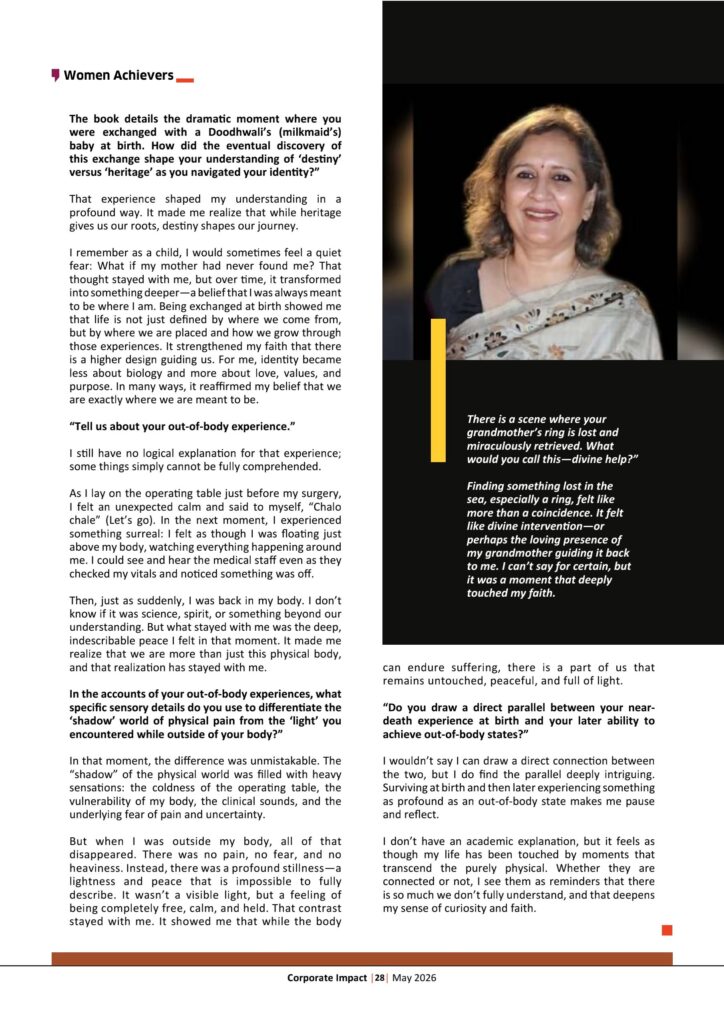
There is a scene where your grandmother’s ring is lost and miraculously retrieved. What would you call this—divine help?”
Finding something lost in the sea, especially a ring, felt like more than a coincidence. It felt like divine intervention—or perhaps the loving presence of my grandmother guiding it back to me. I can’t say for certain, but it was a moment that deeply touched my faith.
“Tell us about your out-of-body experience.”
I still have no logical explanation for that experience; some things simply cannot be fully comprehended.
As I lay on the operating table just before my surgery, I felt an unexpected calm and said to myself, “Chalo chale” (Let’s go). In the next moment, I experienced something surreal: I felt as though I was floating just above my body, watching everything happening around me. I could see and hear the medical staff even as they checked my vitals and noticed something was off.
Then, just as suddenly, I was back in my body. I don’t know if it was science, spirit, or something beyond our understanding. But what stayed with me was the deep, indescribable peace I felt in that moment. It made me realize that we are more than just this physical body, and that realization has stayed with me.
In the accounts of your out-of-body experiences, what specific sensory details do you use to differentiate the ‘shadow’ world of physical pain from the ‘light’ you encountered while outside of your body?”
In that moment, the difference was unmistakable. The “shadow” of the physical world was filled with heavy sensations: the coldness of the operating table, the vulnerability of my body, the clinical sounds, and the underlying fear of pain and uncertainty.
But when I was outside my body, all of that disappeared. There was no pain, no fear, and no heaviness. Instead, there was a profound stillness—a lightness and peace that is impossible to fully describe. It wasn’t a visible light, but a feeling of being completely free, calm, and held. That contrast stayed with me. It showed me that while the body can endure suffering, there is a part of us that remains untouched, peaceful, and full of light.
“Do you draw a direct parallel between your near-death experience at birth and your later ability to achieve out-of-body states?”
I wouldn’t say I can draw a direct connection between the two, but I do find the parallel deeply intriguing. Surviving at birth and then later experiencing something as profound as an out-of-body state makes me pause and reflect.
I don’t have an academic explanation, but it feels as though my life has been touched by moments that transcend the purely physical. Whether they are connected or not, I see them as reminders that there is so much we don’t fully understand, and that deepens my sense of curiosity and faith.