

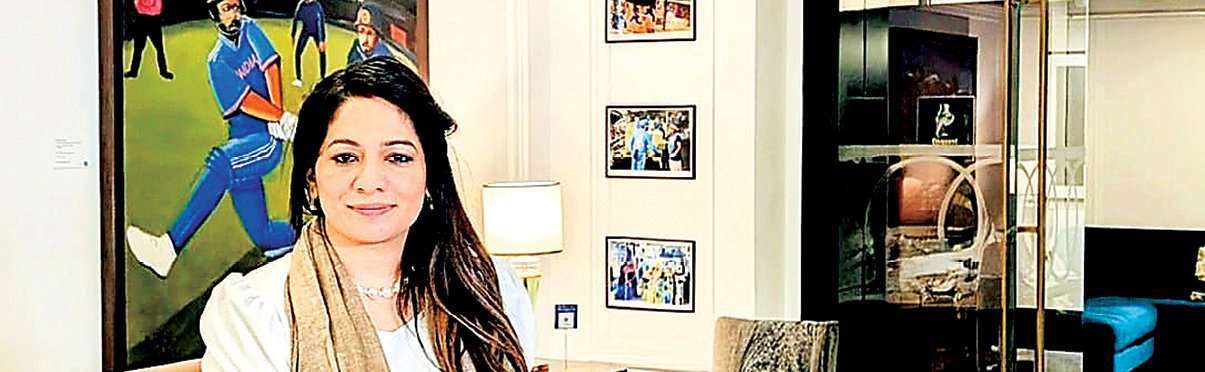
From St. Stephen’s and Delhi University to a Springer Nature Top Cited Book Award, patents, and the ‘Women, AI & Agriculture’ project – how a Political Science professor is bridging governance, technology, and inclusive development for a Viksit Bharat.
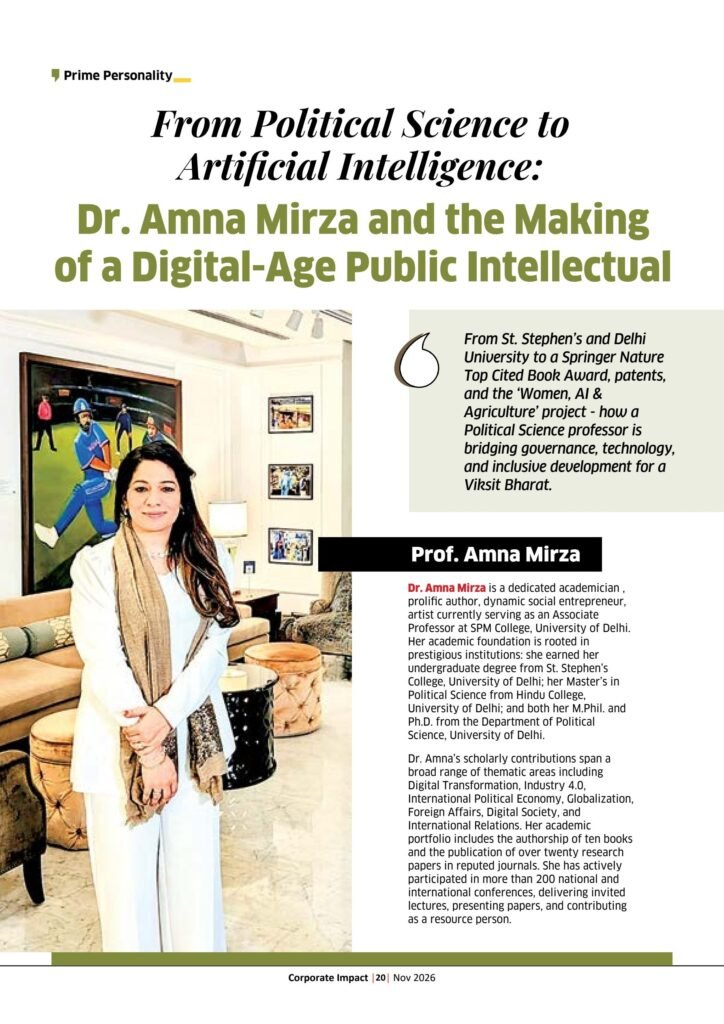
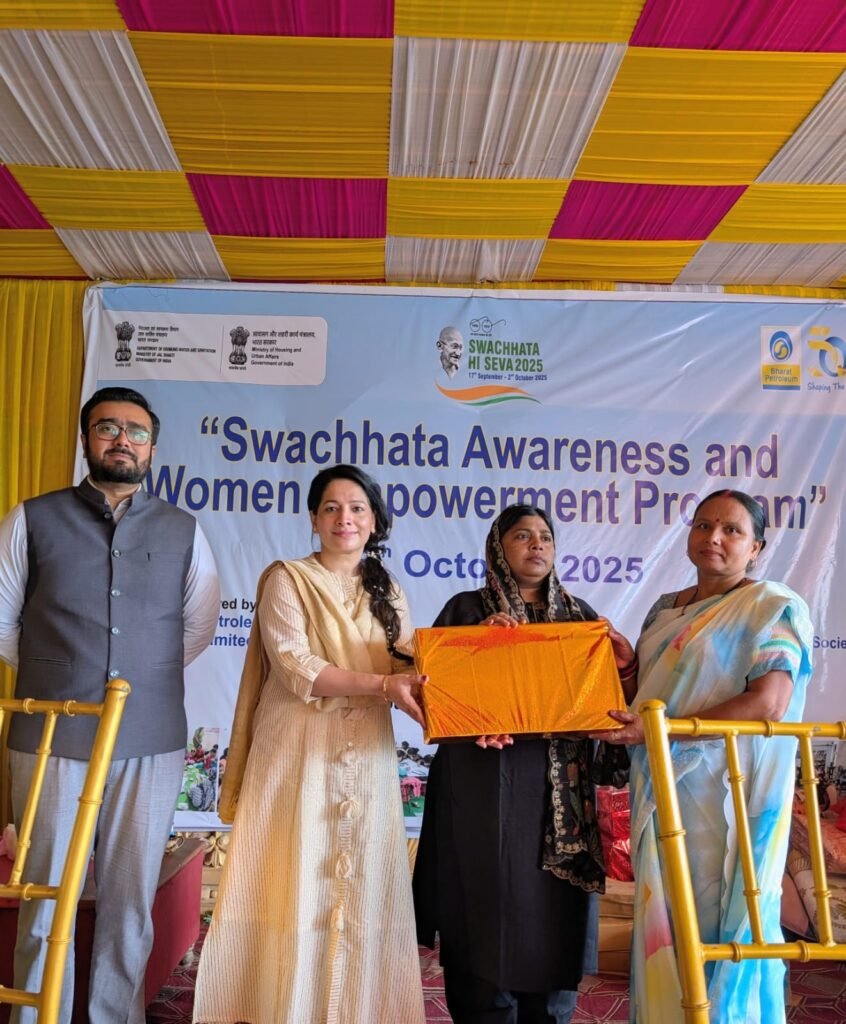
Prof. Amna Mirza
Dr. Amna Mirza is a dedicated academician , prolific author, dynamic social entrepreneur, artist currently serving as an Associate Professor at SPM College, University of Delhi. Her academic foundation is rooted in prestigious institutions: she earned her undergraduate degree from St. Stephen’s College, University of Delhi; her Master’s in Political Science from Hindu College, University of Delhi; and both her M.Phil. and Ph.D. from the Department of Political Science, University of Delhi.
Dr. Amna’s scholarly contributions span a broad range of thematic areas including Digital Transformation, Industry 4.0, International Political Economy, Globalization, Foreign Affairs, Digital Society, and International Relations. Her academic portfolio includes the authorship of ten books and the publication of over twenty research papers in reputed journals. She has actively participated in more than 200 national and international conferences, delivering invited lectures, presenting papers, and contributing as a resource person.
In addition to her academic engagements, Dr. Mirza has supervised Ph.D. candidates, undertaken funded research projects, and contributed to national MOOCs and online learning initiatives. She holds patents granted by the governments of India, reflecting her commitment to research-led innovation and interdisciplinary inquiry. She has also pursued advanced certification courses, including programs from HarvardX, further enhancing her global academic outlook.

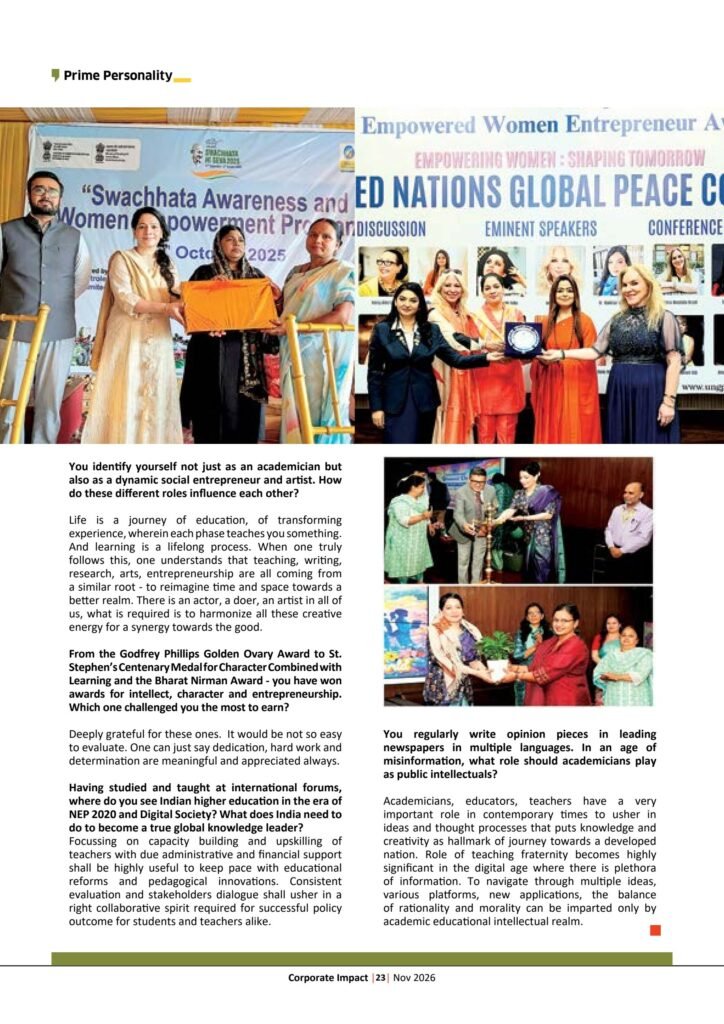
Her academic quest took her to University of Duisburg-Essen in Germany, University of Fribourg in Switzerland, amongst others. Dr. Mirza’s contributions have been recognized through numerous prestigious awards, such as the Godfrey Phillips Golden Ovary Award, the St. Stephen’s College Centenary Medal for Character Combined with Learning, the Bharat Nirman Award for Women Entrepreneurship, the Mook-Nayak National Award, and the Business Rankers Women Achievement Award.
She has also received recently prestigious top cited book award in ‘Business, Economics, Politics & Law in 2021-25’ at Springer Nature Books Summit, for her co-authored book – ‘Digital Transformation, Artificial Intelligence & Society’, Springer and is also project director of research project on ‘Women, AI & Agriculture’, funded by ICSSR Punyashloka Devi Ahilyabai Holkar Special Call for Women-Led Research on Women-Led Development, Government of India.
Beyond academia, Dr. Mirza is actively involved in cultural and intellectual forums. She regularly contributes opinion pieces and columns to leading newspapers in multiple languages and has been associated with a range of art and cultural festivals. An avid traveler, and voracious reader, Dr. Amna brings a deeply interdisciplinary and globally engaged perspective to her educational, social, cultural, artistic, literary and professional endeavors.

She is committed to her mojo in various avatars teaching, writing, social & artistic endeavours, her work echoes that be disciplined and honest with every commitment, prioritize self care, harmony & make every moment count.
A private person with a busy timeline, she is truly what one can say – ‘own reason to smile every day’.. !
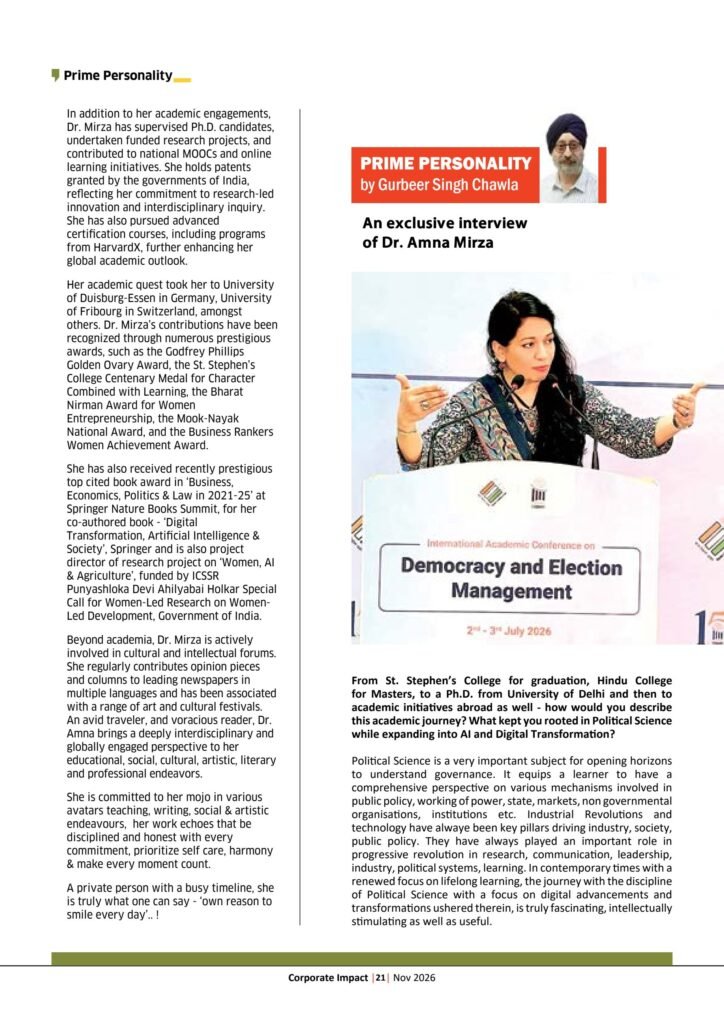
An exclusive interview of Dr. Amna Mirza
From St. Stephen’s College for graduation, Hindu College for Masters, to a Ph.D. from University of Delhi and then to academic initiatives abroad as well – how would you describe this academic journey? What kept you rooted in Political Science while expanding into AI and Digital Transformation?
Political Science is a very important subject for opening horizons to understand governance. It equips a learner to have a comprehensive perspective on various mechanisms involved in public policy, working of power, state, markets, non governmental organisations, institutions etc. Industrial Revolutions and technology have alwaye been key pillars driving industry, society, public policy. They have always played an important role in progressive revolution in research, communication, leadership, industry, political systems, learning. In contemporary times with a renewed focus on lifelong learning, the journey with the discipline of Political Science with a focus on digital advancements and transformations ushered therein, is truly fascinating, intellectually stimulating as well as useful.
Congratulations on the Top Cited Book Award 2021-25 at the Springer Nature Summit for ‘Digital Transformation, Artificial Intelligence & Society’. What is the one key takeaway from the book that you feel every policymaker and student must understand today?
Transitions and changes in industry are an important fact of human evolution. Each industrial revolution presents a phase of challenges and opportunities. What makes the present phase of the fourth Industrial Revolution different and distinct from earlier ones is the nature, scale and speed marked by fusion of technologies. Looking at sweeping changes across various paradigms, it becomes imperative to ensure that it’s inputs and outputs are well balanced to ensure sustainability and inclusiveness for all.
As Project Director for the ‘Women, AI & Agriculture’ under the special call for Women-Led Development, what surprising insights have you found on the ground? How can AI truly empower rural women?
It has been a great experience to understand the ground realities for transition towards Artificial Intelligence and situating in context of women issues in agriculture, mapping across five states. Navigating through AI and gender aspects in case of agriculture can present an important transformative framework to enhance livelihoods, better farming practices, and usher inclusive development in agritech which shall play a key role in path of nation towards the goal of Viksit Bharat.
It’s very inspiring that a Political Science professor holds patents granted by the Government of India. Could you tell us a bit about your patents and how you connect political theory with technological innovation?
An interdisciplinary approach is highly useful to relate theory to reality, gain diverse perspectives and in depth understanding. This is very useful for theoretical disciplines, social sciences, liberal arts and right coordination with quantitative aspects and research methodology imparts a creative tenor to the learning initiatives. The work in this regard has attempted to analyse the practical aspects of concepts in theory and work towards frameworks that can offer working solutions for complex issues of present times.
You have authored 10 books, published 20+ papers, supervised PhDs, created MOOCs, and attended 200+ conferences. What is your mantra for time management and staying disciplined? How do you avoid burnout?
As they popularly rightly say that ‘manage the bandwidth’. Schedule the tasks, be clear in terms of the purpose, balance priorities and pace, be real, value your efforts, indulge in self care and set appropriate boundaries. Understand that balance is never given, it has to be carved out with honesty, discipline and hardwork.
You identify yourself not just as an academician but also as a dynamic social entrepreneur and artist. How do these different roles influence each other?
Life is a journey of education, of transforming experience, wherein each phase teaches you something. And learning is a lifelong process. When one truly follows this, one understands that teaching, writing, research, arts, entrepreneurship are all coming from a similar root – to reimagine time and space towards a better realm. There is an actor, a doer, an artist in all of us, what is required is to harmonize all these creative energy for a synergy towards the good.
From the Godfrey Phillips Golden Ovary Award to St. Stephen’s Centenary Medal for Character Combined with Learning and the Bharat Nirman Award – you have won awards for intellect, character and entrepreneurship. Which one challenged you the most to earn?
Deeply grateful for these ones. It would be not so easy to evaluate. One can just say dedication, hard work and determination are meaningful and appreciated always.
Having studied and taught at international forums, where do you see Indian higher education in the era of NEP 2020 and Digital Society? What does India need to do to become a true global knowledge leader?
Focussing on capacity building and upskilling of teachers with due administrative and financial support shall be highly useful to keep pace with educational reforms and pedagogical innovations. Consistent evaluation and stakeholders dialogue shall usher in a right collaborative spirit required for successful policy outcome for students and teachers alike.
You regularly write opinion pieces in leading newspapers in multiple languages. In an age of misinformation, what role should academicians play as public intellectuals?
Academicians, educators, teachers have a very important role in contemporary times to usher in ideas and thought processes that puts knowledge and creativity as hallmark of journey towards a developed nation. Role of teaching fraternity becomes highly significant in the digital age where there is plethora of information. To navigate through multiple ideas, various platforms, new applications, the balance of rationality and morality can be imparted only by academic educational intellectual realm.