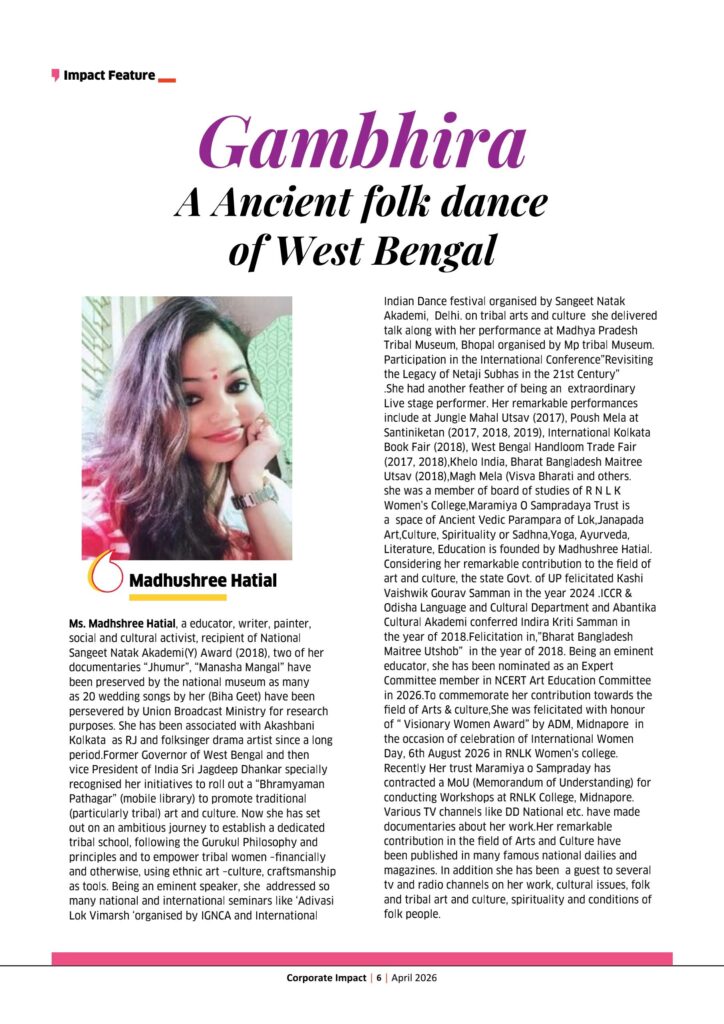



Ms. Madhshree Hatial, a educator, writer, painter, social and cultural activist, recipient of National Sangeet Natak Akademi(Y) Award (2018), two of her documentaries “Jhumur”, “Manasha Mangal” have been preserved by the national museum as many as 20 wedding songs by her (Biha Geet) have been persevered by Union Broadcast Ministry for research purposes. She has been associated with Akashbani Kolkata as RJ and folksinger drama artist since a long period.Former Governor of West Bengal and then vice President of India Sri Jagdeep Dhankar specially recognised her initiatives to roll out a “Bhramyaman Pathagar” (mobile library) to promote traditional (particularly tribal) art and culture. Now she has set out on an ambitious journey to establish a dedicated tribal school, following the Gurukul Philosophy and principles and to empower tribal women –financially and otherwise, using ethnic art –culture, craftsmanship as tools. Being an eminent speaker, she addressed so many national and international seminars like ‘Adivasi Lok Vimarsh ‘organised by IGNCA and International Indian Dance festival organised by Sangeet Natak Akademi, Delhi. on tribal arts and culture she delivered talk along with her performance at Madhya Pradesh Tribal Museum, Bhopal organised by Mp tribal Museum.Participation in the International Conference”Revisiting the Legacy of Netaji Subhas in the 21st Century” .She had another feather of being an extraordinary Live stage performer. Her remarkable performances include at Jungle Mahal Utsav (2017), Poush Mela at Santiniketan (2017, 2018, 2019), International Kolkata Book Fair (2018), West Bengal Handloom Trade Fair (2017, 2018),Khelo India, Bharat Bangladesh Maitree Utsav (2018),Magh Mela (Visva Bharati and others.she was a member of board of studies of R N L K Women’s College,Maramiya O Sampradaya Trust is a space of Ancient Vedic Parampara of Lok,Janapada Art,Culture, Spirituality or Sadhna,Yoga, Ayurveda, Literature, Education is founded by Madhushree Hatial. Considering her remarkable contribution to the field of art and culture, the state Govt. of UP felicitated Kashi Vaishwik Gourav Samman in the year 2024 .ICCR & Odisha Language and Cultural Department and Abantika Cultural Akademi conferred Indira Kriti Samman in the year of 2018.Felicitation in,”Bharat Bangladesh Maitree Utshob” in the year of 2018. Being an eminent educator, she has been nominated as an Expert Committee member in NCERT Art Education Committee in 2026.To commemorate her contribution towards the field of Arts & culture,She was felicitated with honour of “ Visionary Women Award” by ADM, Midnapore in the occasion of celebration of International Women Day, 6th August 2026 in RNLK Women’s college.Recently Her trust Maramiya o Sampraday has contracted a MoU (Memorandum of Understanding) for conducting Workshops at RNLK College, Midnapore.Various TV channels like DD National etc. have made documentaries about her work.Her remarkable contribution in the field of Arts and Culture have been published in many famous national dailies and magazines. In addition she has been a guest to several tv and radio channels on her work, cultural issues, folk and tribal art and culture, spirituality and conditions of folk people.
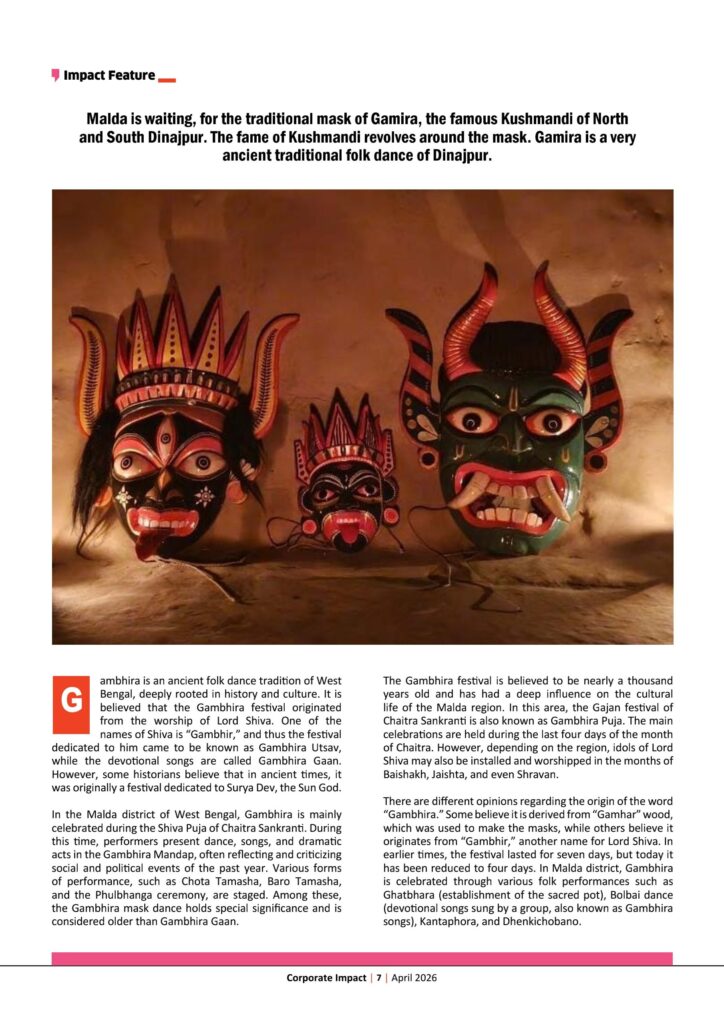
Malda is waiting, for the traditional mask of Gamira, the famous Kushmandi of North and South Dinajpur. The fame of Kushmandi revolves around the mask. Gamira is a very ancient traditional folk dance of Dinajpur.
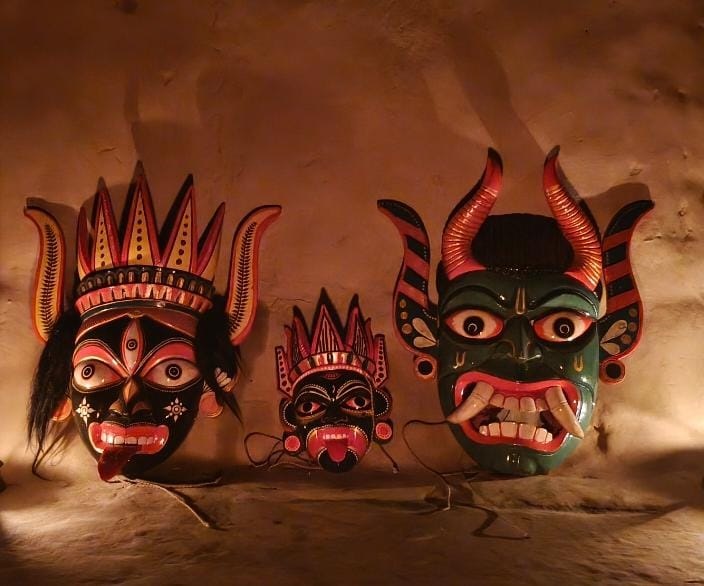
Gambhira is an ancient folk dance tradition of West Bengal, deeply rooted in history and culture. It is believed that the Gambhira festival originated from the worship of Lord Shiva. One of the names of Shiva is “Gambhir,” and thus the festival dedicated to him came to be known as Gambhira Utsav, while the devotional songs are called Gambhira Gaan. However, some historians believe that in ancient times, it was originally a festival dedicated to Surya Dev, the Sun God.
In the Malda district of West Bengal, Gambhira is mainly celebrated during the Shiva Puja of Chaitra Sankranti. During this time, performers present dance, songs, and dramatic acts in the Gambhira Mandap, often reflecting and criticizing social and political events of the past year. Various forms of performance, such as Chota Tamasha, Baro Tamasha, and the Phulbhanga ceremony, are staged. Among these, the Gambhira mask dance holds special significance and is considered older than Gambhira Gaan.
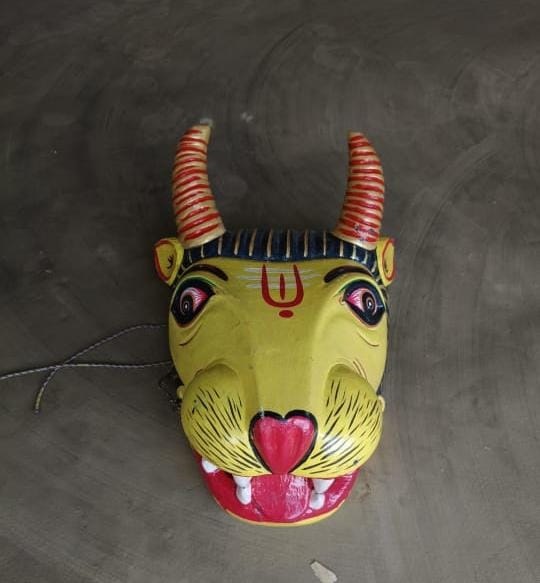
The Gambhira festival is believed to be nearly a thousand years old and has had a deep influence on the cultural life of the Malda region. In this area, the Gajan festival of Chaitra Sankranti is also known as Gambhira Puja. The main celebrations are held during the last four days of the month of Chaitra. However, depending on the region, idols of Lord Shiva may also be installed and worshipped in the months of Baishakh, Jaishta, and even Shravan.
There are different opinions regarding the origin of the word “Gambhira.” Some believe it is derived from “Gamhar” wood, which was used to make the masks, while others believe it originates from “Gambhir,” another name for Lord Shiva. In earlier times, the festival lasted for seven days, but today it has been reduced to four days. In Malda district, Gambhira is celebrated through various folk performances such as Ghatbhara (establishment of the sacred pot), Bolbai dance (devotional songs sung by a group, also known as Gambhira songs), Kantaphora, and Dhenkichobano.
Historically, Gambhira is considered to date back to the Pala period (8th to 12th century). It is also believed to have been mentioned in the travel accounts of the Chinese traveler Hiuen Tsang. Today, Gambhira performances can be seen across various parts of Malda, including English Bazaar, Chanchal, Bamangola, Bachamari, Aiho, Bhutni, Habibpur, Gajol, and Madhughat. A similar mask-based folk dance tradition is also found in Dinajpur, where it is known as Gambhira dance.
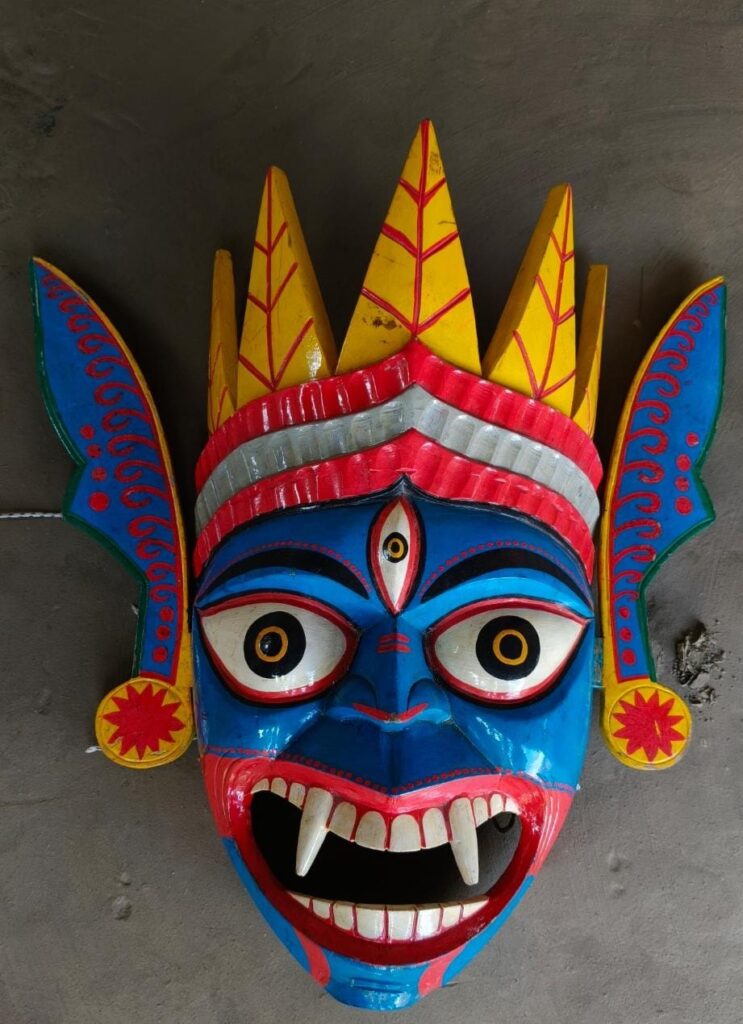
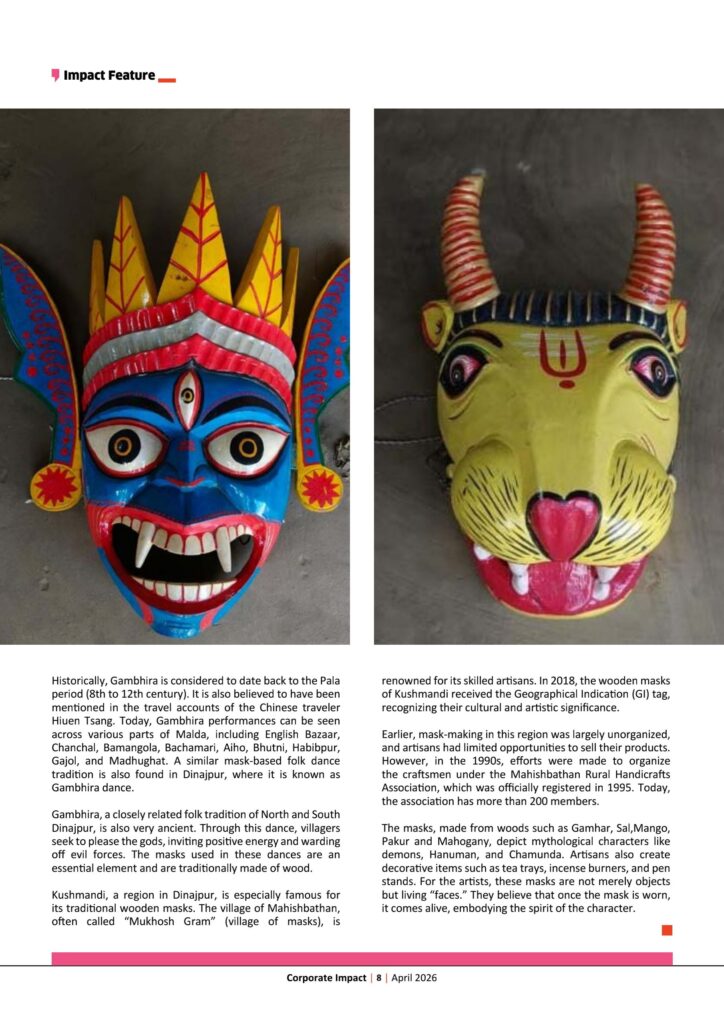
Gambhira, a closely related folk tradition of North and South Dinajpur, is also very ancient. Through this dance, villagers seek to please the gods, inviting positive energy and warding off evil forces. The masks used in these dances are an essential element and are traditionally made of wood.
Kushmandi, a region in Dinajpur, is especially famous for its traditional wooden masks. The village of Mahishbathan, often called “Mukhosh Gram” (village of masks), is renowned for its skilled artisans. In 2018, the wooden masks of Kushmandi received the Geographical Indication (GI) tag, recognizing their cultural and artistic significance.
Earlier, mask-making in this region was largely unorganized, and artisans had limited opportunities to sell their products. However, in the 1990s, efforts were made to organize the craftsmen under the Mahishbathan Rural Handicrafts Association, which was officially registered in 1995. Today, the association has more than 200 members.

The masks, made from woods such as Gamhar, Sal,Mango, Pakur and Mahogany, depict mythological characters like demons, Hanuman, and Chamunda. Artisans also create decorative items such as tea trays, incense burners, and pen stands. For the artists, these masks are not merely objects but living “faces.” They believe that once the mask is worn, it comes alive, embodying the spirit of the character.