



Dr Smita Rashi
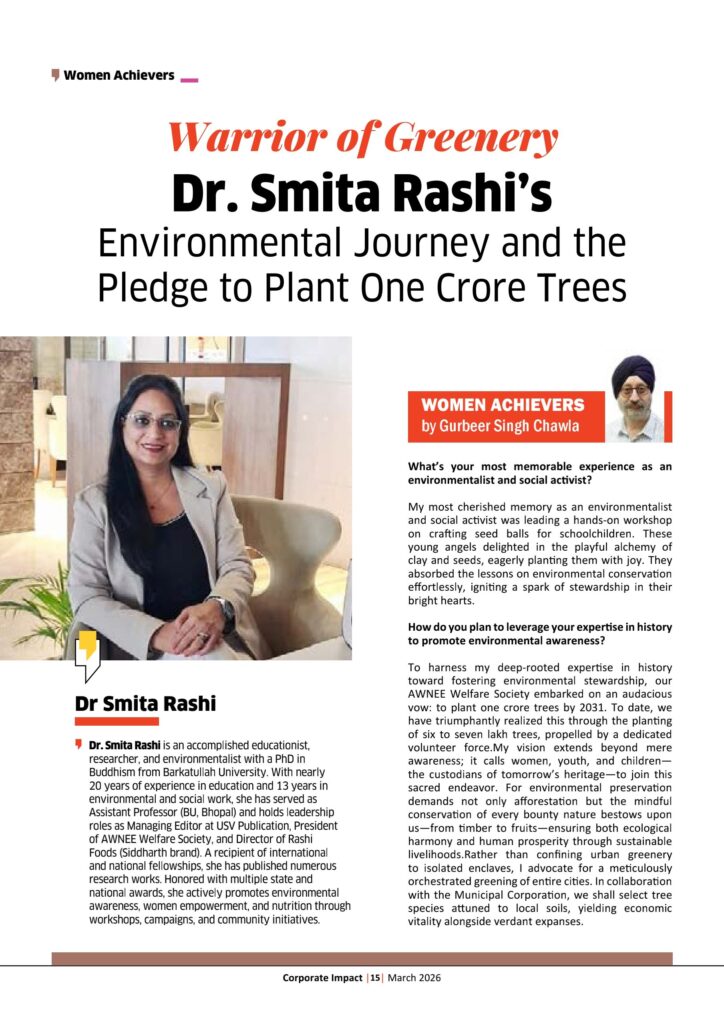
Dr. Smita Rashi is an accomplished educationist, researcher, and environmentalist with a PhD in Buddhism from Barkatullah University. With nearly 20 years of experience in education and 13 years in environmental and social work, she has served as Assistant Professor (BU, Bhopal) and holds leadership roles as Managing Editor at USV Publication, President of AWNEE Welfare Society, and Director of Rashi Foods (Siddharth brand). A recipient of international and national fellowships, she has published numerous research works. Honored with multiple state and national awards, she actively promotes environmental awareness, women empowerment, and nutrition through workshops, campaigns, and community initiatives.
What’s your most memorable experience as an environmentalist and social activist?
My most cherished memory as an environmentalist and social activist was leading a hands-on workshop on crafting seed balls for schoolchildren. These young angels delighted in the playful alchemy of clay and seeds, eagerly planting them with joy. They absorbed the lessons on environmental conservation effortlessly, igniting a spark of stewardship in their bright hearts.
How do you plan to leverage your expertise in history to promote environmental awareness?
To harness my deep-rooted expertise in history toward fostering environmental stewardship, our AWNEE Welfare Society embarked on an audacious vow: to plant one crore trees by 2031. To date, we have triumphantly realized this through the planting of six to seven lakh trees, propelled by a dedicated volunteer force.My vision extends beyond mere awareness; it calls women, youth, and children—the custodians of tomorrow’s heritage—to join this sacred endeavor. For environmental preservation demands not only afforestation but the mindful conservation of every bounty nature bestows upon us—from timber to fruits—ensuring both ecological harmony and human prosperity through sustainable livelihoods.Rather than confining urban greenery to isolated enclaves, I advocate for a meticulously orchestrated greening of entire cities. In collaboration with the Municipal Corporation, we shall select tree species attuned to local soils, yielding economic vitality alongside verdant expanses.

Can you tell us about your journey with AWNEE Welfare Society and the impact of your seed ball plantation drive?
Hailing from Rewa district, my lifelong bond with nature was forged early. My father, a Govt Senior Agriculture Department official, immersed our family in gardens, forests, and bountiful orchards at our tree-lined Civil Lines bungalow, where we siblings cultivated fruits, flowers, and vegetables alongside my mother. This nurturing environment, coupled with my Biology education-emphasizing Botany, grafting, and sapling propagation-ignited my passion for conservation. Rewa’s natural. wonders, from Bandhavgarh and Chachai Falls to research. sites like Dev Kuthar and Satna’s Bharhut Stupa, further inspired me. My PhD in Buddhist philosophy deepened. this, highlighting sacred trees like Neem, Amla, and Peepal, evolving into dedicated environmental action. As a founding member and National President of AWNEE Welfare Society, alongside visionary Vijay Gupta, I championed seed ball plantations-a method boasting 99% germination success. We’ve distributed over 20,000 eco-friendly bird feeders crafted from coconut shells and protective nets, freely across Madhya Pradesh. Esteemed colleagues like J C Chandrashekhar, Rupa Chandrashekhar, Shiv K Pathak, Dr Reenu Yadav, R N Patel, Sanjay Gupta, Ajay Jain, and Namita Gupta-spanning CAs, engineers, doctors, and yogacharyas-propel our mission: one crore trees by 2031.
How do you balance your roles as an educator, environmentalist, and social activist?
As Gautama Buddha wisely observed, “What we think, so we become”—a profound truth that has shaped my harmonious pursuit of roles as educator, environmentalist, and social activist.Inner passion fuels my balance. My profound love for nature, greenery, trees, and plants found expression through AWNEE Welfare Society, where devoted members provided unwavering support and motivation. This endeavor mirrors education itself: I impart knowledge through workshops on safeguarding the environment—teaching scalable techniques like seed balls and hair-fiber extensions—while igniting awareness in communities.Uplifting the elderly and underprivileged women became intertwined goals, blending activism with empathy. Though juggling these demands can feel hectic, unwavering faith and willpower render all things possible, transforming challenges into a seamless symphony of purpose.
Your work has taken you from Rewa to Bhopal – how have these experiences shaped your perspective?
My transition from Rewa to Bhopal unfolded like a tapestry of destiny—initially marked by uncertainty during exams and research sojourns. Yet, as connections blossomed with like-minded souls, these threads wove into a vibrant mosaic, propelling my evolution as an environmentalist, researcher, and educator.Bhopal emerged as a grand stage, amplifying my vision and enabling bold execution. Rewa’s nurturing landscapes instilled a deep-rooted reverence for nature; Bhopal’s dynamic pulse honed my ability to scale impact—merging heritage with action for communities and conservation alike.

What inspired you to transition from computer faculty to teaching history?
To master the realm of technology, I embraced the role of computer faculty—a decision that has since emerged as an invaluable cornerstone of modern education. Its benefits continue to enrich my work to this day.
History has woven itself indelibly into the tapestry of my career, emerging as the principal subject I selected for administrative examinations—a strategic choice that soon blossomed into profound passion. What began as rigorous preparation blossomed into the cornerstone of my scholarly endeavors.
Securing success through the MP SLET competition paved the way for my advanced PhD in this realm, immersing me in research that bridged ancient wisdom with contemporary relevance. From Buddhist philosophy to regional cultural heritage, these pursuits ignited a calling that naturally guided me toward historical education.
Today, as an educator and researcher I channel this evolution to inspire students, fostering not just knowledge but a reverence for our shared legacy—much like my work with AWNEE Welfare Society in environmental stewardship.
Can you share a particularly challenging project you’ve worked on and what you learned from it?
Can you share a particularly challenging project you’ve worked on and what you learned from it?
—be your own lamp, as Gautama Buddha taught—guided me through the trials of establishing myself in new realms. Challenges arose, yet I embraced them as opportunities, forging resilience and adaptability that thrive in any circumstance. Disappointment flickered, but inner fortitude prevailed.
Venturing into unfamiliar territories for research as a woman demanded grit; securing a California University scholarship tested me further, yet my perseverance yielded triumph—earning selection for an All India Indology project under the Ministry of Culture, alongside a Managing Editor role at USV Publications under Anil Singh Sir for the IJPHMR (International Journal of Pedagogy Health and Management Research).
Balancing environmentalism, education, and social activism as a working woman requires unyielding willpower and patience. Raising awareness among women, children, and the underprivileged—on tree plantation, education’s value, and elderly health—demands tireless advocacy. Mothers, as a child’s first teachers, must champion this enlightenment.
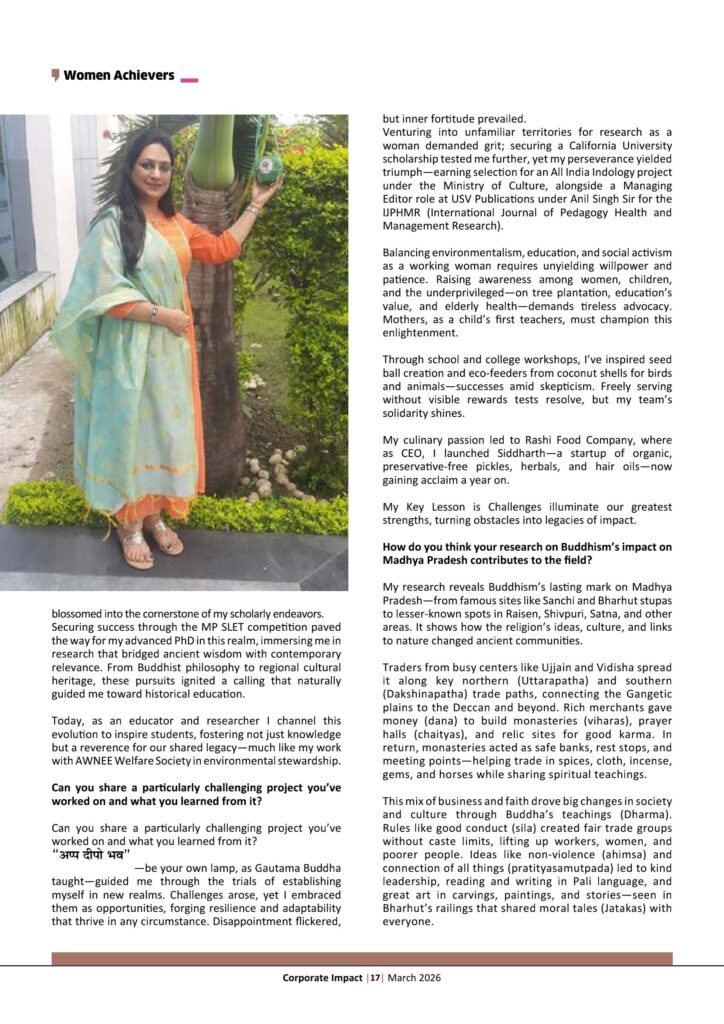
Through school and college workshops, I’ve inspired seed ball creation and eco-feeders from coconut shells for birds and animals—successes amid skepticism. Freely serving without visible rewards tests resolve, but my team’s solidarity shines.
My culinary passion led to Rashi Food Company, where as CEO, I launched Siddharth—a startup of organic, preservative-free pickles, herbals, and hair oils—now gaining acclaim a year on.
My Key Lesson is Challenges illuminate our greatest strengths, turning obstacles into legacies of impact.
How do you think your research on Buddhism’s impact on Madhya Pradesh contributes to the field?
My research reveals Buddhism’s lasting mark on Madhya Pradesh—from famous sites like Sanchi and Bharhut stupas to lesser-known spots in Raisen, Shivpuri, Satna, and other areas. It shows how the religion’s ideas, culture, and links to nature changed ancient communities.
Traders from busy centers like Ujjain and Vidisha spread it along key northern (Uttarapatha) and southern (Dakshinapatha) trade paths, connecting the Gangetic plains to the Deccan and beyond. Rich merchants gave money (dana) to build monasteries (viharas), prayer halls (chaityas), and relic sites for good karma. In return, monasteries acted as safe banks, rest stops, and meeting points—helping trade in spices, cloth, incense, gems, and horses while sharing spiritual teachings.
This mix of business and faith drove big changes in society and culture through Buddha’s teachings (Dharma). Rules like good conduct (sila) created fair trade groups without caste limits, lifting up workers, women, and poorer people. Ideas like non-violence (ahimsa) and connection of all things (pratityasamutpada) led to kind leadership, reading and writing in Pali language, and great art in carvings, paintings, and stories—seen in Bharhut’s railings that shared moral tales (Jatakas) with everyone.
Buddhism also cared for nature, honoring trees like Peepal, Neem, Amla, and Banyan as holy ‘Bodhi ‘spots. This started early ideas for protecting forests, mixing farming with monastery life to keep soil healthy, wildlife safe, and communities strong during city growth from trade.
My work inspires Buddhist Circuit tourism, seed-ball afforestation echoing ancient groves, and interdisciplinary applications in ecology, social equity, and cultural diplomacy—proving MP’s Buddhist network not just preserved Dharma, but ignited holistic human flourishing for generations.
What’s your take on incorporating environmental education into school curricula?
Incorporating environmental education into school curricula nurtures responsible global citizens equipped to tackle climate challenges with practical skills and values from an early age.
Core Benefits
Boosts Critical Thinking: Hands-on projects like analyzing pollution or conservation sharpen problem-solving across science, math, and other subjects
Builds Stewardship Habits: Activities such as gardens, recycling, or seed balls instill lifelong eco-friendly behaviors and community action.
Increases Engagement: Outdoor learning heightens motivation, focus, and academic performance, with studies showing gains in reading, writing, and STEM.
Economic Empowerment
This education merges Buddha Dharma wisdom—like interdependence and ahimsa—with green livelihoods:Micro-Businesses: Workshops teach crafting seed balls, Neem oils, Amla pickles, and eco-feeders, fueling startups like my Rashi Food Company for women and youth income.
Eco-Tourism Jobs: Guides for MP’s Buddhist Circuit (Sanchi, Bharhut) blend history with nature trails, creating homestays and crafts in rural areas.
Sustainable Farming: Sacred groves (Peepal, Neem) yield organic fruits/medicines; chemical-free methods open markets for employment.
Unified Impact
AWNEE Welfare Society initiatives—planting lakhs of trees via joyful school workshops—prove this bridges classrooms to self-reliance, lifting underprivileged women, elders, and children through mindful innovation rooted in ancient sustainability.
What’s next for Dr. Smita Rashi – any upcoming projects or initiatives you’d like to highlight?
AWNEE Welfare Society Vision:
is a term from the Upanishads, which means “the whole earth is one family”, taking into account the idea of keeping the entire earth full of people
Our goal is to plant 1 crore trees by 2031, while strengthening seed ball drives and bird conservation initiatives across schools and communities in Madhya Pradesh. Building on the milestone of 6–7 lakh trees already planted, we aim to inspire young citizens to become active stewards of nature.

Educational Initiatives:
Launching Buddhism-inspired eco-curriculum workshops that connect the heritage of Sanchi Stupa and Bharhut Stupa with modern green skills. These programs will train youth as eco-tourism guides and ethical entrepreneurs.
Research Horizons:
Extending my PhD research on Buddhist trade networks into practical heritage tourism circuits, highlighting cultural sites between Rewa and Bhopal to support cultural preservation and regional economic revival.
Rashi Food Company Expansion:
As CEO, I plan to scale the Siddharth brand of Organic pickles, Herbal products, and Natural hair oils to a national platform through e-commerce. This initiative will also create sustainable livelihood opportunities for women, supported by eco-friendly agroforestry based on Neem and Amla plantations.
Together, these initiatives aim to create a sustainable model where education, heritage, environment, and entrepreneurship empower communities and future generations.